

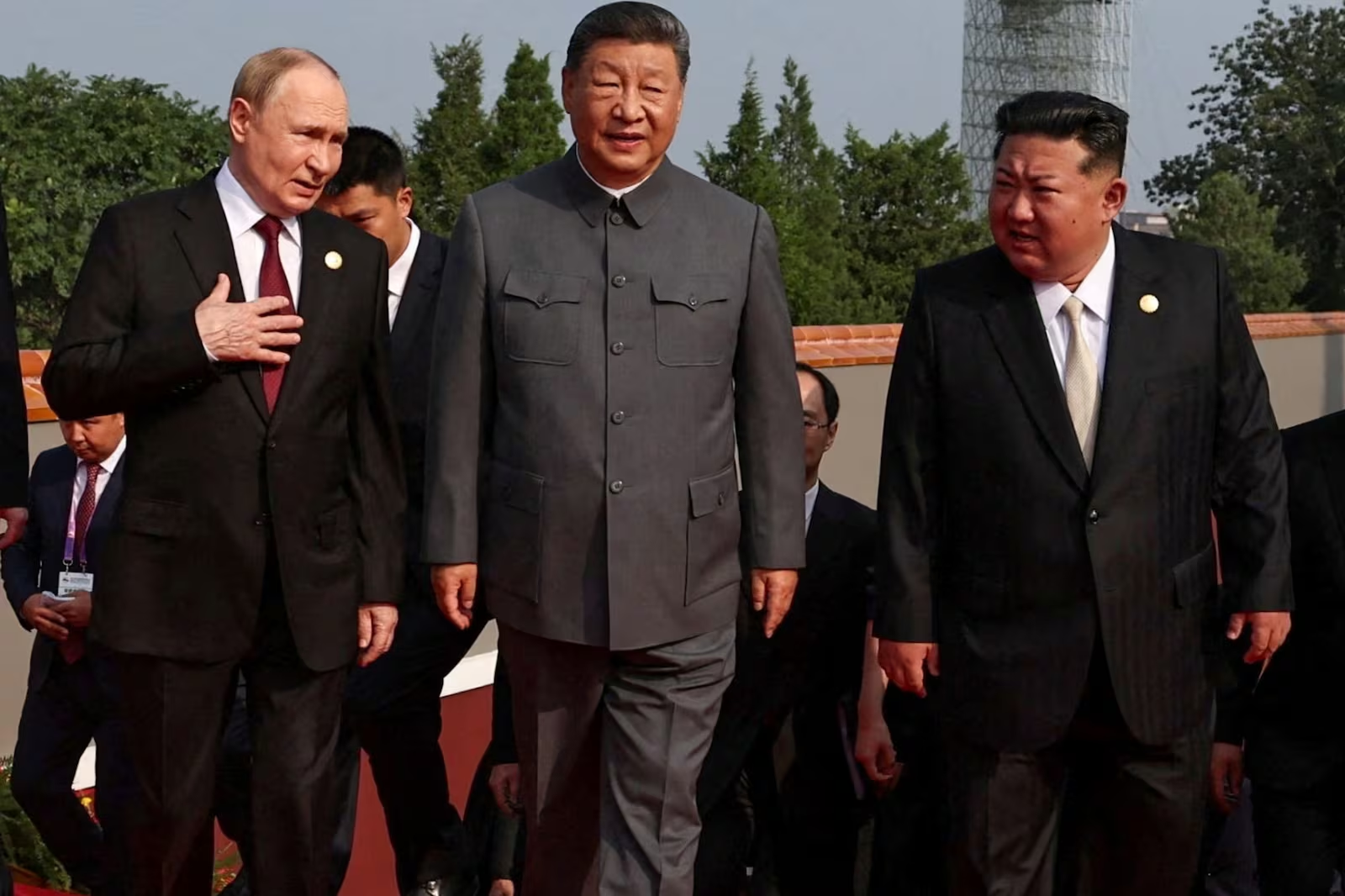
The world is edging towards a Third World War as conflicts in Ukraine and the Middle East threaten to merge into a global confrontation involving Russia, Iran, North Korea and potentially China, a former senior British Army commander has warned.
Colonel Harry Fullerton said the growing links between hostile states, combined with an escalating campaign of sabotage, cyber warfare and attacks on critical infrastructure, had created a dangerous international crisis that could spiral out of control.
The former commanding officer of the Household Cavalry Regiment warned that world leaders risked sleepwalking into a devastating conflict as regional wars increasingly became interconnected.
Speaking on The Security Podcast, he said: “Depressingly, I think the answer is we’re closer to something of a world war than we think, or it’s certainly spreading to become one.”
He added: “I think there is a combination of dreadful circumstances that are merging together.”
Colonel Fullerton warned that conflicts which initially appeared geographically separate were becoming increasingly interconnected through military alliances, weapons supplies and economic disruption.
Iran had supplied Russia with Shahed attack drones for use against Ukraine, while Moscow had provided Tehran with technology and intelligence, he said.
North Korea had also supplied Russia with thousands of troops and large quantities of ammunition, further connecting the war in Europe with growing security tensions in Asia.
Colonel Fullerton said: “The conflict in Iran against Iran is inextricably linked to that of Russia, because Iran, to start with, was helping Russia with Shahed drones and Russia was giving it technology and intelligence.”

He warned that North Korea’s involvement in Ukraine could increase tensions on the Korean peninsula, while China’s ambitions towards Taiwan represented another potential flashpoint.
The economic consequences of the conflicts could also help spread instability, particularly if attacks on energy infrastructure and shipping continued to disrupt international trade.
Colonel Fullerton warned that rising oil prices and shortages of fertiliser could increase food prices, potentially provoking unrest in poorer countries and even across Europe.
“You get more civil wars, you’ll get more uprisings and you could even see that civil unrest coming through Europe,” he said.
He compared the present international situation with the years preceding the two world wars, arguing that conflicts often appeared limited to those not directly involved until they spread into something much larger.
He pointed out that the First World War was initially known in Britain as the Great War and that different countries had different perspectives on when the Second World War began.
Colonel Fullerton suggested that Ukrainians might already consider themselves part of a wider international conflict because of the involvement of Russia’s allies and NATO’s military support for Kyiv.
However, he cautioned that another world war was not inevitable and warned that politicians and military commanders could make matters worse by preparing for a confrontation they increasingly regarded as unavoidable.
“Militaries and politicians can talk themselves into readinesses that can’t almost be reversed,” he said.
Turning to the threat posed by Russia, Colonel Fullerton said Moscow remained a serious danger to Britain and NATO despite the enormous losses suffered by its armed forces during the invasion of Ukraine.

However, he suggested that warnings of an imminent conventional attack against NATO were being overstated.
“The conventional threat is probably not the one that will start a conflict or could be the most damaging,” he said.
He argued that Russia was more likely to continue a campaign of sabotage, cyber warfare and attacks against critical infrastructure, including undersea communications cables and pipelines.
Such operations were relatively inexpensive, difficult to attribute conclusively and allowed Moscow to maintain pressure on Western governments without risking a direct military confrontation.
Colonel Fullerton said: “It’s in the cyber world. It’s in underground cables, underground pipelines.”
He warned that NATO faced a particular difficulty in determining when such attacks should trigger Article 5, the alliance’s collective defence commitment under which an attack against one member is considered an attack against all.
“It’s easy to say if it’s tanks rolling across the border, if it’s missiles landing in your country, and you know where they’ve come from, and it’s physical damage, and people have been killed,” he said.
“It’s quite another when suddenly your internet connection to the United States goes down because something’s happened in the middle of the Atlantic.”
Colonel Fullerton said Russia’s campaign of intimidation was designed to maintain the perception of Moscow as a powerful military adversary while forcing NATO governments to spend increasing amounts on defence.
He suggested that President Putin was using the threat of escalation as leverage against Western governments supporting Ukraine.
The former commander also warned that advances in drone technology and long-range precision weapons had fundamentally changed the character of warfare.
Relatively inexpensive weapons, including drones assembled from commercially available components, could now destroy military equipment worth billions of pounds or strike vital civilian infrastructure.
He said future wars would no longer necessarily be confined to disputed territories or traditional battlefields.
Instead, countries involved in conflicts could find their cities, energy supplies, transport networks and military bases attacked hundreds or thousands of miles from the fighting.
Colonel Fullerton said: “It’s so much easier to build something that’s guided, it’s small, it’s relatively cheap.”
He suggested that the ability of weaker countries to inflict enormous damage on more powerful opponents might eventually deter governments from launching wars.
He also argued that China’s leadership would be studying Russia’s experience in Ukraine before deciding whether to attempt an invasion of Taiwan.
A Chinese assault could cause devastating casualties and destroy much of Taiwan’s semiconductor industry, upon which China and the wider global economy depend.
Colonel Fullerton said the Russian invasion had demonstrated the difficulty of imposing political objectives through conventional military force against a determined opponent.
He estimated that Russia would need approximately ten years to rebuild its armed forces to the strength they possessed before the full-scale invasion of Ukraine in February 2022.
“I think that’s a 10 year plan,” he said.
He argued that while Russia continued to lose troops and equipment, NATO was growing stronger as European governments increased defence expenditure and expanded their military capabilities.
“European NATO is becoming stronger by the day and Russia until their war finishes cannot become any stronger. In fact, they’re obviously going to become much weaker.”
Nevertheless, he predicted that the war in Ukraine would continue because neither side could afford to accept defeat.
Ukraine was fighting for its survival as an independent country, while President Putin could face severe political consequences if Russia failed to achieve its objectives after suffering such enormous losses.
Colonel Fullerton suggested that a diplomatic settlement involving compromises by both sides might eventually be the only way to end the conflict.
Despite his warnings about a possible Third World War, he insisted that maintaining a strong NATO alliance and credible military deterrent remained essential to preventing a wider confrontation.
He said Western leaders needed to combine military strength with diplomacy, while recognising that compromise might ultimately be necessary to prevent further escalation.
“I’m still a believer in a very strong NATO, in strong alliances, in a Western ideology. And there are certain red lines to say we don’t want that crossed.”
Asked whether he remained optimistic about the prospects for peace, Colonel Fullerton replied: “Got to be. Otherwise life’s not worth living.”
