

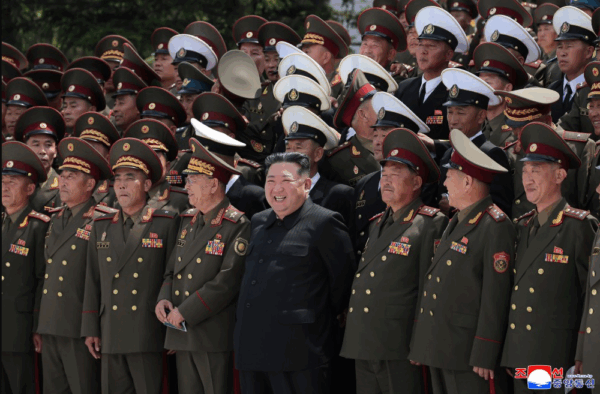
Kim Jong Un, the autocratic leader of North Korea, met with division and brigade commanders from across the Korean People’s Army on May 17, calling for sweeping changes to the military’s training system and organizational structure.
According to a report published on May 18 in the North’s state-controlled media Korean Central News Agency (KCNA), the meeting was held at the Party Central Committee headquarters in Pyongyang, the capital of North Korea, with the attendance of senior military figures including Ri Yong Gil, chief of the KPA General Staff, and Pak Jong Chon, an adviser to the Ministry of National Defense.
Kim said the training system must be overhauled to reflect the changing nature of modern warfare and ordered a restructuring of the military’s organizational and technical setup. He also directed commanders to redefine operational concepts across all domains in line with the KPA’s accelerating modernization.
“We are building a powerful army and affirmed that as already clarified, if the tasks for the period of the Five-Year Plan are carried out, preparedness of the KPA’s strategic action will be renewed beyond comparison with the present and a great change will be made in an aspect of deterring war,” Kim was quoted as saying in KCNA report.
With this, Kim singled out the southern border, which divides North and South Korea, calling for stronger front-line units and describing the reinforcement of border defenses as “a key measure to deter war.” He also said the military’s organizational structure along the border would be remodeled and bolstered in military and technical terms.
Citing progress under the country’s ongoing Five-Year Plan, a defense development program Kim launched in 2021, he said completing the targets of the plan would fundamentally transform the KPA’s strategic capabilities and war deterrence posture.
The military meeting followed a series of missile tests North Korea conducted throughout April, including launches of tactical ballistic missiles equipped with cluster munition warheads and tests of cruise and anti-warship missiles from a naval destroyer. The pattern suggests Pyongyang is methodically expanding the operational breadth of its arsenal rather than conducting isolated provocations.
The remarks came weeks after the South’s National Intelligence Service confirmed that North Korea had amended its constitution to formally abandon reunification as a state goal. The revision of the constitution is believed to have been adopted at a meeting of the Supreme People’s Assembly in March as a measure to codify Kim’s declaration that inter-Korean ties should be treated as relations between two separate and hostile states. In this context, reinforcing North Korea’s southern border appears less a defensive measure than a deliberate effort to entrench a permanent two-state reality on the Korean Peninsula.
