

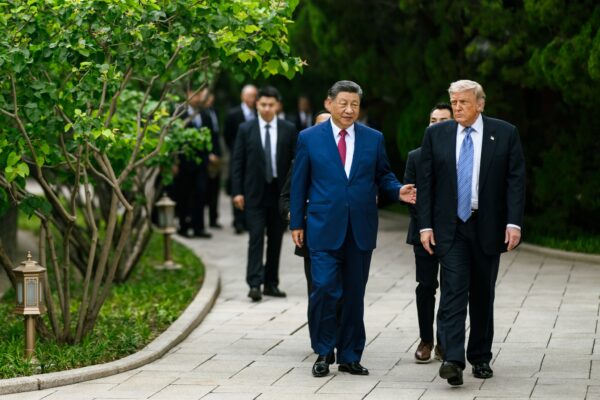
Few political meetings have been anticipated as much as U.S. President Donald Trump’s summit with Chinese Premier Xi Jinping, held in Beijing late last week. It was the first bilateral engagement of its type in a decade and delivered with all the pomp and ceremony that the Chinese could muster.
For the rest of the world, however, it was a two-man show based on their interests. Xi left no doubt in the minds of Americans that Taiwan was at the forefront of his agenda while Trump secured trade deals – soy beans and beef – for farmers back home.
But where did that leave ASEAN and the middle powers struggling with the U.S.-Israel war on Iran and the closure of the Strait of Hormuz?
It remains the world’s biggest issue with the global economy on the brink as emergency stockpiles of oil and gas run low and governments are forced to decide whether to maintain costly subsidies or pass the spiraling costs of energy supplies onto the general public.
Bart Édes, a distinguished fellow at the Asia Pacific Foundation of Canada, followed the summit closely and spoke with The Diplomat’s Luke Hunt about what it did and didn’t mean for the region, where China is adamant about Taiwan.
“President Xi said at the outset that if the U.S. did not handle Taiwan properly, it would risk a clash between the two great powers,” Édes noted.
“He also warned of the Thucydides trap, referring to the Greek historian who observed the clash that occurred when Athens rose to challenge Sparta, a rising power and an existing power, and how over the course of history that has often led to clashes.
“And Xi warned against the relationship heading in that direction,” Édes added.
It was a calculated warning. Trump and Xi may have added some much needed clarity to their relationship but scant attention was paid to the fog of war that is still blowing in from the Middle East, as thick as ever, as the damage bill continues to pile up.
