

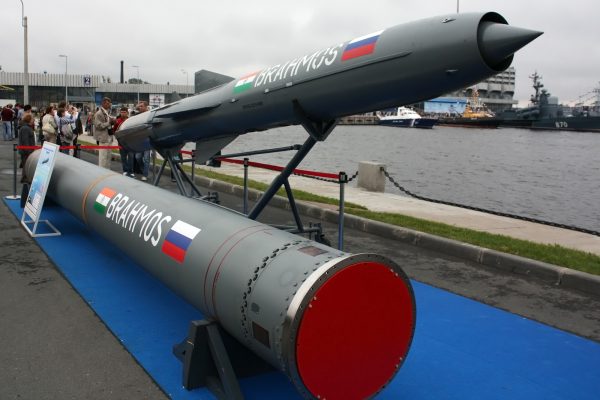
India has signed a deal with Vietnam to equip it with the BrahMos supersonic cruise missile system, while a similar agreement with Indonesia is in the “final stages,” India’s defense secretary said on Saturday.
Responding to a question from a Vietnamese delegate at the Shangri-La Dialogue defense forum in Singapore, Rajesh Kumar Singh told reporters that an agreement with Vietnam had been signed – the first public acknowledgement of a sale that has been rumored for several years.
“My understanding is that with both Indonesia and with Vietnam, the deal is in the final stages, that in fact, for Vietnam, I understand that it has already been signed, probably not publicly announced, but it’s already been signed,” he said, as per a report by ThePrint, an Indian media outlet.
He added, “obviously you are in the category of friendly foreign country with whom we would be happy to share this kind of advanced technology.”
Singh did not disclose any specifics about the deal with Vietnam, but ThePrint cited sources in the defence and security establishment as saying that the deal to sell the BrahMos missile to Vietnam was signed last fiscal year. “They said that given the sensitivities involved, the deal was never publicly announced till now,” the outlet reported.
Last month, Reuters also reported that a deal with Vietnam could be worth about 60 billion rupees ($629 million), including training and logistical support. It said that the issue was likely to have been discussed during Vietnamese President To Lam’s state visit to India in early May.
Vietnam is set to become the third Southeast Asian nation to agree to purchase the BrahMos system, which was developed by BrahMos Aerospace, an India-Russian joint venture that was set up in 1998. The world’s fastest supersonic cruise missile, it can be launched from submarines, ships, aircraft, or land platforms, and flies at nearly three times the speed of sound, making it nearly impossible for targets to evade.
This has unsurprisingly made it attractive to a number of Southeast Asian governments that are in need of a potent deterrent against Chinese incursions into waters that these nations claim in the South China Sea.
In early 2022, the Philippines closed a $374 million deal to acquire three BrahMos missile batteries, with the aim of strengthening the ability of the Armed Forces of the Philippines to safeguard its sovereign claims in the South China Sea. The first of these was delivered in April 2024.
In March of this year, Indonesia said that it had finalized an agreement with India to procure BrahMos cruise missiles. Indonesia has expressed an interest in purchasing the system since at least 2018, as a potential upgrade of the ship-based Russian-origin Yakhont supersonic anti-ship cruise missile that the Indonesian Navy has operated since 2011.
Although the Indonesian government did not confirm the total value of the agreement, one Indian media report stated that the agreement would include “the sale of one battery comprising launchers, radars, and missiles.” They also said that it was set to be signed after Indonesia had organized the financing, which one report said would be within “two to three months.” Singh’s remarks at the Shangri-La Dialogue suggest that the two nations will put ink to paper soon.
An agreement with Vietnam would notch another success for India’s domestic defense manufacturing industry, and frank its increasing importance as a supplier of arms to Southeast Asia – a region wary of becoming overly dependent on either the United States or China for military procurements.
It would also mark an important step forward in its defense relationship with a key regional partner. Hanoi occupies a key position in New Delhi’s Act East Policy, which seeks to advance relations with Southeast Asia, and its goal of ensuring stability in the Indo-Pacific. Since the signing of a comprehensive strategic partnership in 2016, trade between Vietnam and India has grown at a healthy rate, albeit from a low base. However, the real progress has been in the area of security, where the two nations share concerns about China’s growing maritime power and assertiveness.
In June 2022, Indian Defense Minister Rajnath Singh and his then-Vietnamese counterpart Gen. Phan Van Giang signed a “Joint Vision Statement on India-Vietnam Defense Partnership Towards 2030,” which the Indian Defense Ministry said intended to “significantly enhance the scope and scale of existing defense cooperation.” They also signed a Memorandum of Understanding on Mutual Logistics Support, “the first such major agreement which Vietnam has signed with any country.”
Thailand and Malaysia have also all shown an interest in acquiring the BrahMos missile system.
