

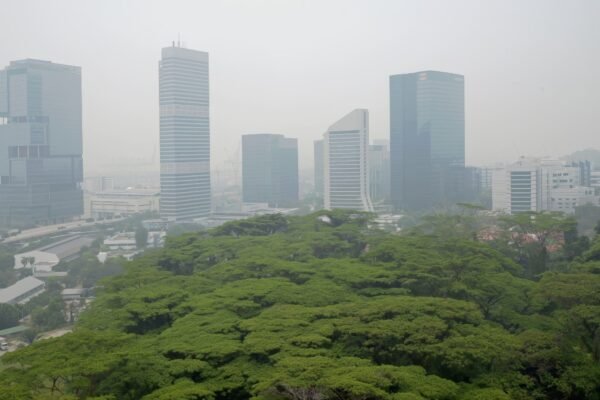
Air pollution readings in some parts of Singapore yesterday spiked to their highest levels in more than a decade, as Indonesia came under increased pressure for its failure to contain the wildfires that have caused a dramatic decline in air quality across the region.
Hourly PM2.5 readings rose across all regions of Singapore yesterday afternoon, with the reading in the west of the island climbing to 288 micrograms per cubic meter. The reading, which is in the National Environmental Agency (NEA)’s “very high” range, was the highest recorded since 2015, Channel News Asia reported.
PM2.5 readings were in the “high” range in the south, east, and central regions of the country, while the reading in the north was in the “elevated” range.
With readings entering the “very high” range, the government also began the phased distribution of N95 masks to vulnerable segments of the population, and temporarily closed all outdoor and non-air-conditioned sports facilities in western Singapore.
Indonesia is currently battling the most intense wildfire season in 11 years, which has been exacerbated by an unusually severe dry season linked to a global El Niño weather pattern. The fires, which are concentrated mostly on the islands of Borneo and Sumatra, have created a haze that has affected much of maritime Southeast Asia, forcing school closures and impacting the health of tens of millions of people.
The government of Timor-Leste, which borders Indonesia, said in a statement yesterday that it was suspending face-to-face learning activities for three days starting from October 15 “due to contamination by pollutant particles from wildfires in neighboring regions or countries.” This comes after the Malaysian government last week ordered the closure of schools across peninsular Malaysia, including in the capital Kuala Lumpur, due to the worsening haze.
In Indonesia, authorities said more than 280,000 respiratory problems have been recorded in affected regions since August 18. In the province of Central Kalimantan, the country’s ISPU air pollution index yesterday exceeded 1,200, four times higher than the “hazardous” level of 300.
While some fires naturally occur during the annual dry season, many are caused by agricultural burn-off on monoculture plantations, such as palm oil, maize, paper pulp, and sugar, that are controlled by powerful Indonesian conglomerates. The country’s Forestry Minister Raja Juli Antoni said last month that most of the fires in Kalimantan and Sumatra had been deliberately set by individuals or companies, and pledged to investigate and punish those responsible.
As I noted earlier this week, the crisis has highlighted the inadequacy of regional mechanisms for combating transboundary haze. Malaysia this week announced that it would raise the issue with Association of Southeast Asian Nations (ASEAN) foreign ministers ahead of the bloc’s summit in the Philippines next month.
For now, however, the region is reliant on the actions of the Indonesian government, which has been subject to increasing criticism for its failure to contain – or prevent – the fires. In addition to a wave of complaints from Singaporean and Malaysian social media users, the frustration is now breaking into the political realm. Andrew Chen Kah Eng, the head of the Johor state branch of Malaysian Prime Minister Anwar Ibrahim’s Pakatan Harapan coalition, said on Monday that Indonesia “must be held accountable” for its failure to contain the wildfires.
“Indonesian spokespeople need to stop being indifferent and unapologetic to all ASEAN countries affected, including its own people, by human-induced haze pollution,” he said. “Allowing toxic haze containing PM2.5 fine particles to pollute the air of neighboring countries is unacceptable.”
The following day, Malaysian lawmaker Syed Saddiq Syed Abdul Rahman called on Southeast Asian governments to lodge formal diplomatic protests with their Indonesian counterparts, suggesting that Malaysian and Singaporean banks cut off financing to Indonesian companies linked to land burning. “You need to treat them like an outcast in the region,” he said.
On Tuesday, Indonesian President Prabowo Subianto ordered the mobilization of additional resources to combat the wildfires, which are particularly difficult to control due to the fact that many are in geographically remote areas and are burning on areas of dried peatland, where fires can smolder for weeks underground.
“This is a top priority for us. We must resolve it immediately,” Prabowo told a meeting with the relevant Indonesian authorities, according to a government statement.
Even if it is successful, without continuing action to control the activities of powerful agri-business interests, the region will continue to be subject to the choking externalities of Indonesia’s dysfunctional political economy.
