

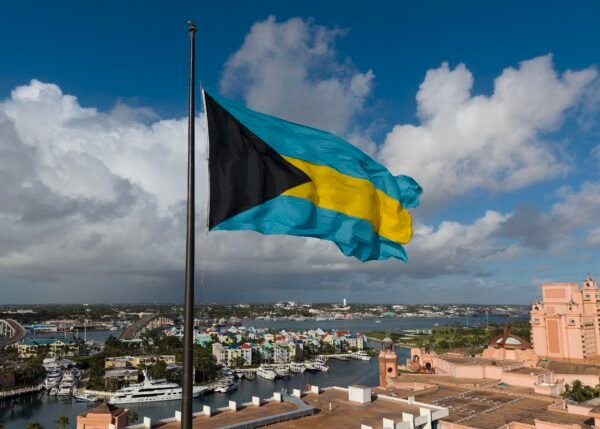
The December 2025, the U.S. National Security Strategy (NSS) committed the U.S. to resisting influence by extrahemispheric actors, including control over strategic assets and shipping corridors in the Western Hemisphere. Today, China has accumulated a strategically problematic commercial presence and web of influence relationships in the Bahamas. The archipelago is just 80 kilometers from the United States at its closest point, nearer than Cuba. U.S. military maritime routes for deploying and sustaining forces go through the islands, which the State Department has called the U.S. “third border.”
Beijing’s presence in the Bahamas and its military implications for the U.S. are often overshadowed by discussion of Chinese activities in Cuba, the Panama Canal, the Port of Chancay, Peru, or the “Deep Space Radar” facility in Neuquen, Argentina. However, China’s influence in the Bahamas is just as problematic, both in peacetime and if the U.S. had to transit through the archipelago to deploy and sustain forces supporting action against the Chinese in the Indo-Pacific. While that presence appears more commercial and political than military, it includes a labyrinth of China-controlled businesses in the Bahamas and relationships with its political, military, and commercial figures that could give Beijing options to observe – and potentially threaten – U.S. forces.
A map of the Bahamas. Credit: Shutterstock.
Business Projects
Chinese commercial ventures in the Bahamas boost Beijing’s influence – and in the worst case could support and provide cover for People’s Liberation Army or Ministry of State Security operatives. Such ventures include port operations, hotels and resorts, other construction projects, and an array of telecommunication and electricity sector activities.
The Hong Kong-based firm Hutchison is the operator of the Bahamas’ principal port and container terminal at Freeport, as well as its cruise ship terminal. Hutchison is currently engaged in a $100 million modernization effort there, bringing cranes and other equipment that have been associated in the past with data security concerns.
China’s flagship commercial ventures in the Bahamas include the $4.2 billion Baha Mar resort, owned by Macau-based Chow Tai Fook Enterprises. The venture’s Chinese-owned builder, China Construction America (CCA), was found by U.S. courts to have caused $845 million in damages by defrauding and breaching its contract with the original developer Sarkis Ismirlian.
Other significant Chinese commercial operations involving CCA and its owner, the China State Construction and Engineering Company, include The Pointe, the associated Margaritaville Resort, and the nearby British Colonial Nassau hotel. The China-based owners have long defied Bahamian government control with the workers they maintain on the property. Examples include the government’s arrest of 65 Chinese nationals doing renovations on the British Colonial Hotel with improper work authorizations. The Pointe was also found to employ 229 Chinese nationals and 35 other foreign workers versus only 90 Bahamians, although the Chinese company’s agreement with the government required that 70 percent of the workers be locals.
Beyond hotels, Chinese companies have established a presence through a loan-financed hospital, renovation work on the national stadium, which they previously built, and a gifted “demonstration farm,” creating an opening for regular visits by Chinese personnel.
In the telecommunications sector, which presents risks for the compromise of sensitive government, commercial, and personal data, Huawei is a major supplier to the national telecom operator ALIV, as well as BTC. In 2013 Huawei Marine Systems was selected to upgrade BTC’s BDSNi fiber-optic network, including submarine cables.
In the equally sensitive digital surveillance sector, China’s Hikvision provided more than 2,000 cameras at the Chinese-operated Baha Mar casino, among other work in the country.
Chinese companies also have a significant presence in the Bahamas’ energy sector, particularly solar projects. Examples include Chinese-based Sungrow, which provided an energy storage system on Sampson Cay, and Chinese-based Kehua and GSL, which similarly supplied solar sector products and services. Huawei advertises itself as an integrator for solar solutions in the country.
People-to-People Ties
As a complement to its investments in the Bahamas, the Chinese has built an extensive web of relationships and influence with military, political, and other figures.
According to their own reporting, the Royal Bahamas Defense Force (RBDF) and Royal Bahamas Police Force (RBPF) regularly send personnel to China for courses. Six RBDF personnel participated in training at Chinese military, naval, and air force institutions in 2025. Specifically, RBDF personnel have attended training in China on maritime law enforcement and Chinese language.
On the police side, RBPF Deputy Commissioner Leamond Deleveaux reportedly attended a “Peaceful Resolution Course” in China.
For security forces, such personal relationships have been complemented by periodic gifts of material, including two Tiger armored vehicles in August 2017, equipment for the military band in November 2024, as well as donations of advanced workout equipment, jet skis, and harbor patrol equipment from the Chinese-affiliated Baha Mar Foundation.
The web woven by Beijing through its people-to-people diplomacy, however, extends far beyond the military. The Chinese government reportedly brought 100 Bahamians to China during the past year alone, including parliamentarians, senior security officials, doctors, nurses, students, and business representatives. In July 2026, China brought representatives from both of the country’s major political parties, the Progressive Liberal Party and Free National Movement, to Beijing for party-to-party consultations.
During the past year, the Chinese hosted significant Bahamian groups for the first “China-Bahamas Forum on Dialogue Among Civilizations,” and separately, the first “China-Bahamas Trade and Economic Cooperation Forum.” In October 2026, 23 Bahamian doctors and nurses are scheduled to travel to China for a medical event.
For a country with a population as small as the Bahamas, the Chinese government has been very active in courting its journalists, particularly those from The Tribune, Eyewitness News, and other organizations. Prominent recent examples include Leandra Rolle of The Tribune, who attended a July 2026 seminar in China called “on Media Co-operation on World Political Parties”; Genea Noel of Eyewitness News and Alicia Wallace, who attended a China-paid three-week Caribbean Media Exchange in June-July 2026; and Jade Russell from The Tribune, who spent three weeks in Shanghai in April 2025 for a training program for International Young Talents from “Belt and Road Countries.” Less recently, Ricardo Wells of The Tribune went on four-week visit to China in May 2018; Rashad Rolle, also of The Tribune, attended a three-week journalism seminar in September 2015; and Eric Rose, of the Bahamas Information Services, served as a panelist in a July 2015 film festival event.
Many of these trips resulted in enthusiastic op-eds on China and the “lessons” it offers the Bahamas.
Beyond media, as in other countries, the Chinese government-staffed Confucius Institute at the University of the Bahamas has played an important role in capturing young Bahamians interested in China, its language, and culture. What began as a Confucius Classroom in 2009 became a full Confucius Institute in October 2012. By 2019, the institute had trained over 1,000 students and had brought over 100 Bahamian teachers and students to China.
Conclusion
While the majority of Chinese engagement in the Bahamas is not military in character, the extent of the presence and influence it affords China in a country just 80 kilometers from U.S. shores – and along routes strategically important for the U.S. in a war in the Pacific – should draw Washington’s attention. Given the U.S. administration’s strong record in acting on the policies and priorities it has highlighted in the NSS, that possibility should make the Chinese presence in the Bahamas a matter of concern for the Bahamian government as well.
