

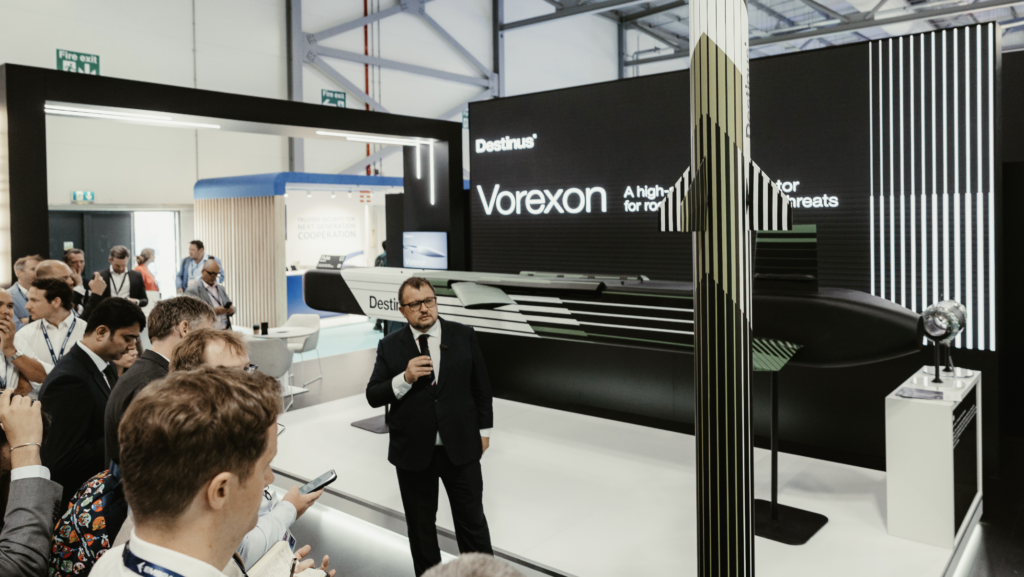
FARNBOROUGH — Dutch company Destinus has unveiled a new counter-rocket interceptor that is being developed to address what the firm says are blind spots in European integrated air defense.
Dubbed the Vorexon, the ground-based interceptor is designed to address defense vulnerabilities in Europe, including the swift detection and identification of incoming projectiles to strike a defended area and “only engage threats that threaten priority assets,” Mikhail Kokorich, the CEO of Destinus, said Monday at the Farnborough Airshow here.
The system remains under development, but the company aims for a maximum speed above Mach 2 and an engagement range beyond 20 kilometers (12.4 miles). It is designed to operate within an integrated sensor and fire-control network and is equipped with external radars to spot and classify incoming shells.
Upon being launched, the interceptor receives midcourse corrections until a radar locks onto the target for the final attack, but engagement decisions remain “under operator command,” Destinus said in a press release.
The company expects Vorexon to undergo operational testing next year and is eyeing 2028 to launch mass production. The system has been envisioned to protect critical military infrastructure such as command posts, air-defense radars and batteries, logistics hubs and ammunition stores against artillery rockets and glide bombs.
No launch customers have yet been announced, but Kokorich told Breaking Defense they are in discussions with several European countries, including Ukraine. Destinus’s RUTA Block 2 mini-cruise missile is already in use on the frontline in the fight against Russia, according to the company.
During the presentation of the new interceptor, the CEO also linked the need for such systems to lessons learned from the war in Ukraine, where heavy artillery bombardments have highlighted the high cost of stopping every shell.
“No economically viable interceptor architecture can [currently] engage every round — cost is as decisive as capacity: artillery rockets are inexpensive and produced in large numbers, so defeating them with high-cost interceptors shifts cost exchange in favour of the attacker,” a company press release said.
The UK-based Institute for the Study of War reported on July 19 that Russian troops have launched 107 ballistic missiles and 20 Zircon missiles since the start of the month, surpassing the country’s monthly missile manufacturing capability.
