

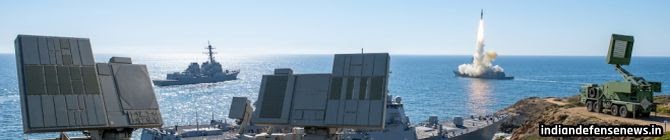
The Defence Research and Development Organisation has been advancing shared
aperture antenna technologies that combine multiple frequency bands into a
single consolidated array.
This approach allows different bands to operate simultaneously without
interference, saving considerable space, reducing overall weight, and
cutting installation costs.
By interleaving elements or employing advanced structural designs, the
organisation ensures that band isolation is maintained while achieving
compact integration.
The S‑band, which typically operates between 2 and 4 GHz, is particularly
suited for long‑range tracking functions. It provides reliable detection and
monitoring of aerial targets over extended distances, making it
indispensable for surveillance and early warning systems.
The X‑band, operating between 8 and 12 GHz, is optimised for high‑resolution
Synthetic Aperture Radar imaging and precision targeting. Its ability to
deliver fine detail makes it critical for strike missions and battlefield
reconnaissance.
To accelerate development, the Technology Development Fund has been issuing
Requests for Information to industry partners. These calls invite
collaboration on prototyping and refining shared aperture antenna systems
for use in radar, communications, and electronic warfare. Independent
researchers and DRDO institutes have already begun fabricating prototypes
using shared‑aperture array techniques and microstrip configurations, such
as 2×2 arrays.
These prototypes are being tested to evaluate electromagnetic isolation
between the S‑band and X‑band, ensuring that signals remain distinct and
uncontaminated.
Design Verification Modules play a central role in validating the compact
sizing and power efficiency of Active Electronically Scanned Array
configurations. For example, X‑band transmit‑receive plank units are tested
digitally before full‑scale fabrication begins.
This step ensures that the modules meet stringent performance requirements
and can be scaled up without compromising efficiency or reliability. Only
after these digital verifications are successful does the organisation
proceed to physical production, thereby reducing risk and ensuring quality.
The shared aperture concept represents a significant leap in radar and
communication technology. By consolidating multiple frequency bands into a
single antenna system, DRDO is not only reducing the logistical footprint
but also enhancing operational flexibility.
Such systems are expected to be deployed across airborne platforms, naval
vessels, and ground‑based installations, offering a unified solution for
surveillance, targeting, and secure communications. The ability to integrate
long‑range tracking with high‑resolution imaging in one antenna array
underscores the sophistication of this technology.
This initiative also aligns with India’s broader push for indigenous defence
modernisation. By fostering collaboration between government research
institutes and private industry, the programme ensures that expertise is
shared and innovation is accelerated.
The prototypes being tested today will form the foundation for advanced
systems capable of meeting the demands of modern warfare, where multi‑band
operation and compact integration are increasingly vital.
Shared-aperture AESA engineering addresses several operational limitations
found in legacy mechanical tracking systems.
Operating S and X bands out of a single aperture requires solving complex
microwave engineering problems: Mutual Coupling: To keep high-frequency X-band
signals from distorting low-frequency S-band signals, DRDO utilizes mutual
complementary configurations.
Electromagnetic Transparency: S-band radiating structures are
engineered with specific micro-slots or multi-loop gaps. This makes them
completely “EM transparent” to incoming or outgoing X-band waves, allowing the
higher-frequency elements to fire right through them without beam scattering.
