

Canadian Prime Minister Mark Carney’s speech at the World Economic Forum brought the concept of the “middle power” back into the spotlight. Delivered amid U.S. President Donald Trump’s hints of seizing Greenland and an ongoing tariff war with Canada, the speech was suffused, in its every turn of phrase, with cautious jabs at the United States.
Carney argued that over recent decades of globalization, “great powers have begun using economic integration as weapons.” In order to counter this risk, he said, middle powers should band together – even with countries that do not share their values – to strengthen their strategic autonomy. As a first step, he urged the world to confront the fact that the “rules-based international order” the United States had taken the lead in building was, in truth, a fiction. Without naming the United States outright, Carney declared that his country would “stand firmly with Greenland and Denmark” and voiced strong opposition to tariff measures targeting Greenland – a clear, if indirect, rebuke of Trump.
Carney’s speech, which drew considerable attention in Japan as well, was received as something of a tonic against the perceived values-free domestic and foreign policy the United States has pursued since the start of the second Trump administration. But is middle-power diplomacy actually viable? And if it were such a rational choice, why has this concept only now suddenly resurfaced?
According to Michael Beckley of the American Enterprise Institute, the recent surge of attention toward “middle powers” is not a reflection of rising relative power among self-styled middle powers like Canada, but rather the result of fierce China-U.S. economic competition that has “exposed” their vulnerability. Beckley further noted that there have been few periods in history when middle powers could actually survive as such, observing that for much of recorded human history, “more than half of humanity lived under the domain of just three to five empires.” It was only with the onset of the Cold War, he argued bluntly, that small and medium-sized states were able to behave as “middle powers” at all – and only by pledging allegiance to either the American or Soviet camp.
Beckley is not alone: a broadening swath of mainstream American security experts has grown critical of Carney-style middle-power theorizing, which presumes that countries can somehow rise above the logic of great power politics. Manjari Chatterjee Miller of the Council on Foreign Relations, for instance, characterized Carney’s speech as a “call to arms” and warned that if countries heed that call, the result will be “the fragmentation of the international order, the possibility of multiple new competing orders, and the emergence of a more dangerous world.”
Imran Bayoumi of the Atlantic Council went further. He argued that a coalition of middle powers, far from being capable of creating a new order, in fact lacks any capacity to construct order in the first place. According to Bayoumi, even China cannot serve as a viable substitute for the United States, meaning that the middle powers ultimately cannot escape their dependence on Washington.
Indeed, even Carney himself, for all his fierce criticism of U.S. economic pressure, issued a statement of support – however lukewarm – for the airstrikes on Iran that the Trump administration began in earnest from late February this year. When it comes to security matters, the reality is that no country can afford to simply disregard U.S. wishes.
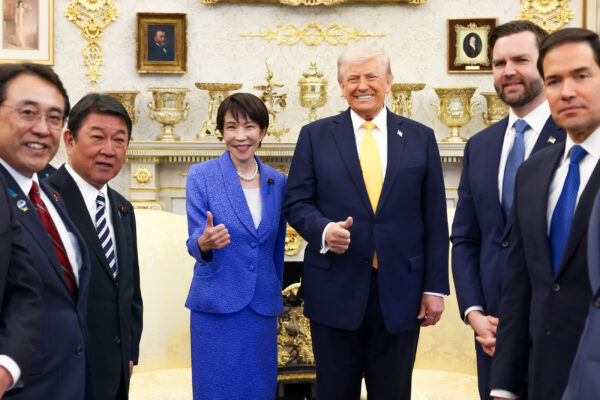
While Carney’s defiance drew criticism, Japan’s deference has been winning increasing praise within the discourse on middle powers. Michael Green, a leading American authority on Asia policy, compared Carney with Japanese Prime Minister Takaichi Sanae and argued for the merits of Japan’s strategy. Rather than adopting a posture of resistance toward the United States, Japan squarely confronts the more serious threat posed by China while actually seeking to strengthen its relationship with an increasingly unpredictable United States.
Hal Brands, a prominent American international relations scholar, likewise praised Japan’s approach in an essay titled “Japan Is Becoming the Superpower of the Middle Powers.” He commended Tokyo’s efforts to build up its military strength so as to compensate for a United States that is scaling back its commitment to Asia.
What emerges from American commentary is the suggestion that the formulaic language Japanese officials use when discussing Japan-U.S. relations – phrases like “the Japan-U.S. alliance is the cornerstone of Japanese foreign policy” or “the United States is Japan’s only ally” – in fact embodies a remarkably astute strategic judgment. At a moment when the rest of the world is keeping its distance from the United States, Japan has deliberately drawn closer, thereby extracting a continued U.S. commitment to Asia. Japan has even advanced investment plans between the two countries on a scale unmatched by any other nation.
It is abundantly clear that U.S. commentators praise Japan’s proactive diplomatic posture and defense efforts precisely because doing so serves U.S. national interests – and Japanese direct investment in the United States is, naturally, more than welcome. It is precisely for this reason that Japan has earned rising acclaim from U.S. observers as an entity that complements, rather than threatens, the United States – in other words, as the “model middle power.”
Yet Japan is not deepening its ties with the United States out of charity. Through increased defense spending and investment in the United States, Japan bolsters its support from the world’s most powerful military. For a Japan situated in “the most severe and complex security environment” it has ever faced, that U.S. support is indispensable to strengthening deterrence.
At the same time, as the United States pushes for a return of manufacturing to its own shores and raises market barriers, securing access to an American market that continues to generate new industries is likewise squarely in Japan’s national interest.
