

On June 30, South Korean President Lee Jae-myung approved the appointment of Han Sung-sook as prime minister, making her South Korea’s second female prime minister after Han Myeong-sook, who held the post from 2006 to 2007. Han Sung-sook takes office July 1 as the 50th prime minister and the second under the Lee administration.
The National Assembly passed Han’s confirmation motion the same day by a vote of 166 in favor to one invalid ballot, out of 167 lawmakers present. The main opposition People Power Party did not participate, citing unresolved allegations over illegal building extensions at Han’s property. The party had also boycotted the earlier vote to adopt Han’s confirmation hearing report.
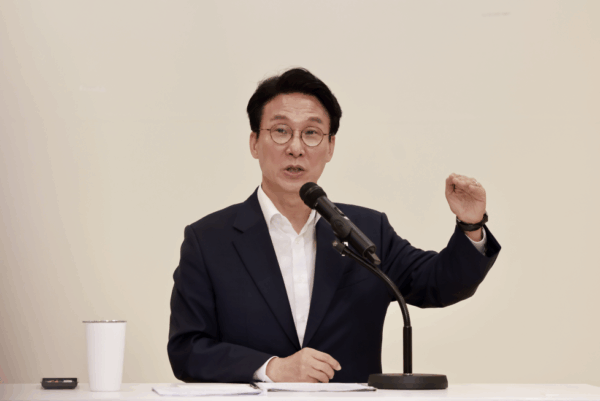
Presidential Chief of Staff Kang Hoon-sik announced Han’s nomination on June 7, describing her as suited to lead South Korea through an era of rapid artificial intelligence transformation given her background as a technology executive and her year as the country’s first minister of SMEs and startups. Kang also credited outgoing premier Kim Min-seok with the government’s record so far, a remark that took on added weight once Kim’s own political plans became clear.
Although he has not yet announced his bid officially, it’s widely believed that Kim offered his resignation after the June 3 local elections in order to run for chair of the ruling Democratic Party at its August convention. On June 8, marking his own first anniversary in office, Lee said it seemed more appropriate for Kim to take on another role, a comment many took as support for Kim’s bid to run for the chairship of DP.
The campaign now sets up a three-way contest for the August 17 convention among Kim, veteran lawmaker Song Young-gil, and Jung Chung-rae – the outgoing DP chair whose stint as party leader has consistently been questioned by the core supporters of Lee. Last week, Jung stepped down as party leader in what was seen as a step toward seeking another term.
Behind the personnel change lies a broader frustration inside the presidential Blue House over the pace of legislation. During a senior secretaries’ meeting on June 15, Kang said that 569 of 782 bills tied to the government’s policy agenda – nearly three-quarters of its legislative wishlist – remained stuck in the National Assembly. This is despite the DP having a massive majority in the legislature. Kang also said 41 tasks were running behind schedule and 11 of them delayed more than six months, urging his staff to identify where interagency friction was slowing the work. Lee has voiced similar impatience in public remarks about this issue.
Kang and Lee’s frustration did not target the main opposition party. The DP controls the majority of the National Assembly but, according to Kang, it failed to support Lee’s statesmanship clearly.
Some of the frustration traces back to Jung. On January 22, the KOSPI first crossed the 5,000-point mark – a grand milestone Lee had made as a signature campaign promise. Rather than celebrating the economic win, Jung called an emergency press conference to propose a merger with the minor Rebuilding Korea Party. Senior DP lawmakers learned of Jung’s press conference only 20 minutes before he announced it. Several DP lawmakers later said the proposal buried what should have been the Lee administration’s biggest economic accomplishment of the year.
Similar complaints resurfaced in June when Jung’s camp and Kim’s camp traded blame over the DP’s uneven showing in the local elections. Considering Lee’s approval ratings and the political atmosphere surrounding the local elections, the DP should have won a landslide victory, including the by-elections for the National Assembly seats. The actual results didn’t live up to the DP and Lee supporters’ expectation. The party failed to retake the mayorship of Seoul and some key DP candidates were defeated by the PPP. Even in the competitive races that the DP did win, the margin of votes was narrow, demonstrating the party’s campaign failed to make the most of its many advantages.
In this context, Jung’s push for a second term has drawn criticism even within his own camp. The party leader traditionally serves a single two-year term; Jung took office in August 2025, taking up the chairship after Lee resigned the post to run for president.
Jung has framed his candidacy around finishing prosecutorial reform and other incomplete changes. He also emphasized that he and Lee are all in the same boat, implying that their success and failure are bound together.
However, the race is also understood as a contest over who will control candidate nominations for the 2028 parliamentary elections, which is the central power of the next party leader. Due to this background, Jung’s insistence to run for another term is widely seen as a maneuver to secure his post in the parliamentary elections. He may not be able to secure the nomination if he loses in the DP chair election in August.
The upcoming party leadership election is crucial for Lee. The DP already holds a commanding majority in the National Assembly and the speaker’s post. As of June 30, it also kept the chairship of the Legislation and Judiciary Committee, which de facto functions as a senate. The committee can effectively block any legislation.
With nearly every institutional lever in friendly hands, the stalled 73 percent of Lee’s own policy agenda is not a story about the opposition. It reflects strain inside the ruling party itself. In light of this background, whether Kim succeeds in becoming the next leader of the DP will determine how much Lee can achieve in the next four years.
