

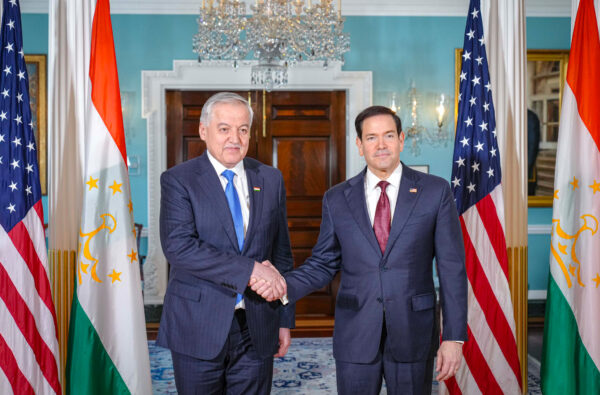
U.S. Secretary of State Marco Rubio met Tajik Foreign Minister Sirojiddin Muhriddin in Washington on June 30, using the encounter to press for expanded commercial engagement in critical minerals and deeper security and counterterrorism cooperation. Rubio framed the meeting on social media around minerals and terrorism. The same day, the two governments held their Annual Bilateral Consultations — the first under the second Trump administration and, by the State Department’s own account, a restart after a four-year pause.
The Tajik readout was broader, listing trade, investment, energy, transport infrastructure, and the digital economy alongside standard language on extremism and transnational crime. But Washington’s interest seems to be narrower and more concrete: antimony.
The metal hardens ammunition, is used in semiconductors and flame retardants, and has no easy substitute in several defense applications. Tajikistan is the world’s second-largest antimony producer, accounting for roughly a quarter of global output. Its antimony reserves are the third largest in the world, and that’s with only 6 percent of Tajikistan having been geologically surveyed.
In December 2024, China (which dominates the market) banned antimony exports to the United States, which imports 20,000-25,000 tons a year, mostly from Chinese suppliers. Prices roughly doubled. For an administration in Washington that has made mineral supply chains a priority, Dushanbe suddenly matters — and the U.S. is not the only bidder. The European Union already draws more than half its antimony from Tajikistan and is chasing the same supply.
Although Washington recognized Tajik independence nearly 35 years ago, in the first part of this century the United States (and its NATO allies) treated Central Asia mainly as a logistics platform for the war in Afghanistan, resulting in the Northern Distribution Network, non-lethal security aid, and a French base at Dushanbe’s airport that emptied out by 2014 (the U.S. left its base in neighboring Kyrgyzstan that same year).
The C5+1 platform, launched by then-Secretary of State John Kerry in 2015 under the Obama administration, aimed to engage the region beyond Afghanistan but underwhelmed for a decade. The chaotic 2021 withdrawal of U.S. forces from Afghanistan then reminded regional capitals how quickly the U.S. can leave and the security repercussions of its absence. Russia’s war in Ukraine and the resulting sanctions did more to revive American appeal than any U.S. initiative, rerouting trade and pushing Central Asian states to diversify.
The November 2025 C5+1 tenth-anniversary summit was the second such gathering at the head-of-state level, following a conversation on the sidelines of the 2023 U.N. General Assembly in New York hosted by then-President Joe Biden. But the 2025 summit was the first to bring all five Central Asian presidents to the White House.
For Dushanbe, the summit produced tangible returns: more than $3 billion in commercial deals involving U.S. and Tajik companies, alongside billions more with the other Central Asian states. Assistant Secretary of State for South and Central Asian Affairs Paul Kapur praised Tajikistan’s border security role and its State Partnership Program ties with Virginia, and Dushanbe agreed to host the upcoming B5+1 business forum. Two months earlier the two governments had signed a five-year health cooperation memorandum.
But the U.S. and Tajikistan have yet to sign a single antimony contract — the mineral at the center of Washington’s agenda for Tajikistan.
China holds a majority of the mining permits in Tajikistan and buys much of what the country digs up; Russia takes most of the rest. The largest antimony operation, TALCO Gold’s Konchoch complex, is a joint venture with a Chinese partner, and its output moves north and east, not west. The U.S. accounts for just 2.1 percent of Central Asia’s critical mineral exports.
Dushanbe has its own reasons to move slowly. In October it hosted Russian President Vladimir Putin and signed 16 agreements deepening an alliance with Moscow, on which roughly 1.2 million Tajik labor migrants and remittances equivalent to a third of the country’s GDP still depend.
Days before the Rubio meeting, Kazakhstan became the first Central Asian capital to join Pax Silica, the U.S.-led bloc built to pull critical minerals, semiconductors, and AI infrastructure out of China’s orbit. Tajikistan, which holds a mineral the initiative was designed to secure, is not a member. Its opening to the United States, for now, amounts to a readout, a memorandum, and an invitation to a business forum, while the antimony keeps flowing to China.
