

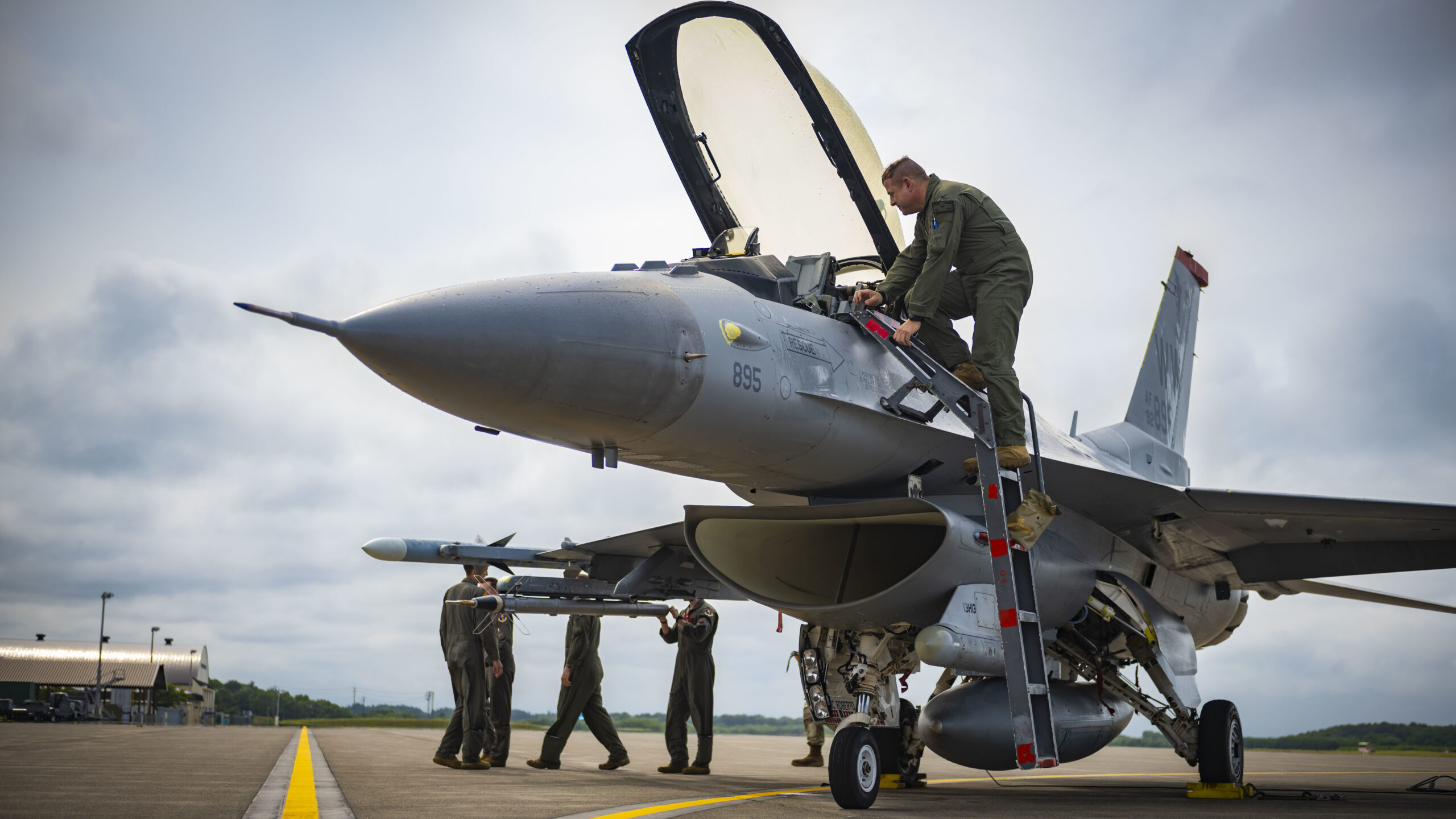
FARNBOROUGH — The US Air Force has suspended a competition for new ejection seats on its F-16 Fighting Falcon fighter jets, nearly two years after announcing it would compete a deal that was previously awarded to RTX subsidiary Collins Aerospace, Breaking Defense has learned.
The program was paused June 5, and “a comprehensive assessment of operational requirements and acquisition alternatives” is now underway, an Air Force spokesperson said in a statement to Breaking Defense.
Asked whether officials still plan to put a new seat in the F-16, the Air Force spokesperson said, “Future integration plans and deployment timelines will be determined based on the recommendations provided following the conclusion of a comprehensive assessment of operational requirements and acquisition alternative[s].”
Collins won the contract for the Next Generation Ejection Seat program as a sole-source deal in 2019, but after the effort to integrate its ACES 5 seat hit delays, officials decided to review the deal with Collins by querying industry again in August 2024. A few months later, the Air Force formally announced that while it would keep Collins as the supplier for a new ejection seat on the F-15, it would compete the company’s deal for the F-16, and possibly extend a contest to the F-22 and B-1 as well.
The reopening of the deal offered a chance for British ejection seat manufacturer Martin-Baker to compete for F-16 seats and potentially those for the F-22 and B-1, which the sole-source deal to Collins had previously foreclosed. Martin-Baker is pitching the US18E that the company touts as already qualified for foreign exports of the F-16. (The ejection seat market for Western aircraft is a virtual duopoly between Collins and Martin-Baker.)
Asked whether the Air Force still planned a competition and new seat integration for the Raptor and Lancer, the Air Force spokesperson said that the service will “determine the acquisition and modernization strategies for the F-22 and B-1 platforms following the final decision on the F-16 ejection seat strategy.”
Regarding the suspension, a Collins spokesperson said in a statement to Breaking Defense that the firm’s ACES 5 seat on offer for the program “was designed and built in the United States alongside combat pilots and builds on the proven safety record of the ACES seat family. ACES 5 meets the U.S. Air Force’s rigorous technical and safety requirements proven through multiple qualification tests.”
The company is “committed to working with our customer on their timeline to ensure pilots receive the highest level of protection when their need is greatest,” the spokesperson added.
Steve Roberts, who leads business development for Martin-Baker, confirmed to Breaking Defense the company received notice of the suspended competition in June, noting that the Air Force communicated a 90-day review period for a final decision. “We don’t know why” the competition was suspended, Roberts said in an interview on the sidelines of the Farnborough airshow here outside of London.
Despite the announcement of the recompete in 2024, Roberts said “nothing happened” in the intervening time since. “Our ask is really to just rerun the competition in line with” the Air Force’s prior reopening of the deal, he said.
In his view, Roberts said a number of possibilities are now on the table. The Air Force could proceed with a competition for just the F-16; run a contest for both F-16 and F-22; keep Collins as the current vendor, or “terminate NGES altogether” — meaning those jets would retain legacy Collins ACES II seats. Roberts said a competition for B-1 seats appeared to be “off the table,” considering the bomber was not included in previous market surveys.
Collins’s ACES 5 is separately slated for use in the Air Force’s forthcoming T-7 Red Hawk training jet, and has been selected to replace seats in the B-2 Spirit stealth bomber. The company previously told Breaking Defense that the first bomber received new seats in November 2024.
