

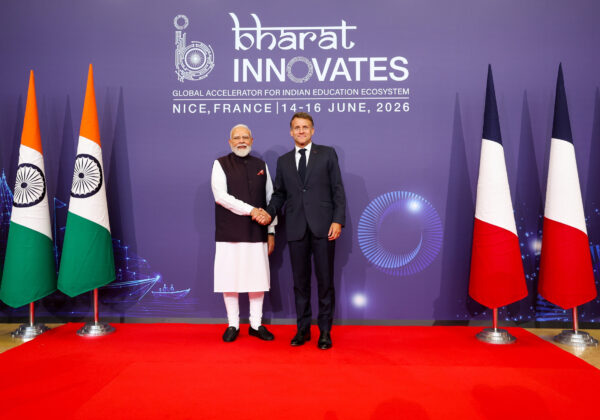
Nice, a Mediterranean city in southeastern France, was chosen by India’s Ministry of Education to host the Bharat Innovates summit from June 14 to 16. In the first time the event was held outside India, it brought together more than 120 Indian start-ups alongside French and European innovation actors.
Inaugurated one day before the beginning of the G-7 summit in Évian, the gathering also provided an opportunity for French President Emmanuel Macron and Indian Prime Minister Narendra Modi to meet once again. It was Modi’s eighth visit to France since taking office, underscoring the remarkable momentum of the France-India partnership. The program of this visit – focused on innovation, artificial intelligence and emerging technologies – illustrated how far bilateral relations have evolved beyond their traditional strategic and defense foundations.
Meetings between French and Indian leaders have become routine. What made this one noteworthy was its location. Why Nice?
France’s fifth-largest city is increasingly serving as a diplomatic showcase. Nice offers an attractive combination of international visibility, Mediterranean splendor, and a degree of distance from the formalism associated with the French capital.
Modi’s visit is no isolated case. In fact, it bears a striking resemblance to the visit Chinese President Xi Jinping paid to the city in 2019. More recently, Nice hosted the third United Nations Ocean Conference (UNOC III) in 2025, during which France convened its sixth France-Pacific regional summit.
Together, these events suggest that Nice is no longer merely a tourist destination but an increasingly important venue for French diplomacy, with a particular emphasis on the Indo-Pacific region.
A Contested Border Town That Became a Tourism Capital
Founded by Phocaean Greeks in the 4th century BCE as Nikaia, Nice successively came under Roman, Ostrogothic, Genoese, Savoyard, and Piedmontese rule before becoming definitively French in 1860 – later than some of France’s present-day Indo-Pacific overseas territories. Once a contested frontier town, Nice gradually transformed into one of Europe’s leading tourist destinations. Successive waves of visitors, exiles, and artists helped forge its cosmopolitan identity. From the late 19th century onward, the city’s development was remarkably rapid, fueled by growing international demand for seaside leisure and winter resorts.
Initially a fashionable winter resort for the British aristocracy, Nice later attracted Russian émigrés fleeing the Bolshevik Revolution, as well as American expatriates and socialites of the Roaring Twenties, including F. Scott Fitzgerald and Ernest Hemingway. Artists, writers, and intellectuals also flocked to the city, drawn by its climate and distinctive light, emblematic of what came to be known as the Côte d’Azur. The introduction of paid holidays in France in 1936 democratized tourism and transformed Nice into a mass tourist destination. Today, the city boasts the second largest hotel capacity in France after Paris.
This cosmopolitan legacy, combined with modern infrastructure, has transformed Nice into a geopolitical crossroads.
Geopolitical Crossroads and Diplomatic Showcase
Despite its geographical position nestled between the Mediterranean and the Alps (as reflected in the name of the department, Alpes-Maritimes), Nice has benefited from the development of its airport.
Nice Côte d’Azur Airport has become a key infrastructure for regional and international connectivity. Ranking as France’s second busiest after Paris (Roissy and Orly combined), Nice’s airport handles 15 million passengers across more than 120 destinations in 45 countries, with nearly two-thirds of its traffic on international routes. A structuring tool for the territory, it makes this geographically constrained city one of the best-connected in Europe.
Add Sophia Antipolis – Europe’s largest technology park, home to over 2,000 French and foreign firms and easily accessible from Nice – and the picture of a genuine crossroads emerges.
The city has therefore become a venue of choice for diplomatic summits. In 2019, Xi preceded Modi in the Azurean capital with a visit whose program was almost identical (including staying at the same hotel, the Negresco, and a retreat at the same venue, the Villa Kérylos). But the most significant event was UNOC III — the third United Nations Ocean Conference, held in Nice from June 9 to 12, 2025. Billed as the largest global event ever dedicated to the oceans, it convened over 10,000 participants, including 63 heads of state and government and 174 national delegations.
Building on this diplomatic momentum, it was a logical step for the Indian Ministry of Education to select Nice as the venue for Bharat Innovates
Who Will Innovate With India?
While the France-India relationship was traditionally centered on defense procurement – notably Rafale jets and Scorpene submarines – it now aims to develop new domains: technology, innovation, and AI. In Nice, the Bharat Innovates summit was its showcase, with 120 Indian start-ups across 13 key sectors (such as energy, smart cities, mobility, space, and health), on display. For French companies in the region, it was a rare opportunity to meet India’s most dynamic innovators directly.
This event fit seamlessly into the continuity of recent bilateral encounters. A year after co-chairing the AI Action Summit in Paris in 2025, Macron and Modi reconvened for the India AI Impact Summit in New Delhi, during Macron’s official trip to India in February 2026 – a visit that also took him to Mumbai, where the two leaders launched the France-India Year of Innovation.
AI is a domain where the China-U.S. duopoly looms large. India has real room to maneuver by pooling influence with Europe and other middle powers, thereby loosening structural dependencies in the process. Macron’s formulation in Mumbai, echoed again in Nice, set the tone: “The question is no longer whether India innovates – it is who will innovate with India.”
In this evolving bilateral dynamic, which now extends beyond ministerial summits and reflects a sustained political and economic continuum between Paris and New Delhi, the Bharat Innovates summit appeared less as a standalone event than as a territorial manifestation of this upgraded partnership. For the city of Nice, it was not an isolated occurrence but part of a broader transformation of the city into a diplomatic and economic platform, where international events increasingly intersect with its identity as a showcase for innovation and global engagement.
Gateway to the Indo-Pacific
Nice is a Mediterranean city, not an Indo-Pacific one – a geographical fact no diplomatic calendar can alter. However, hosting international events in Nice demonstrates a French diplomatic practice of direct significance to Paris’ Indo-Pacific strategy: the deliberate leveraging of high-prestige metropolitan venues to maintain equidistant relations with Asia’s two great powers, while framing engagement through innovation, multilateralism, and climate action rather than traditional security paradigms.
Paris’ Indo-Pacific strategy, formalized in 2018, rests on the assertion that France – as a resident Indo-Pacific power with permanent presence and legitimate interests – advocates a “third way.” That approach is grounded in core principles: upholding a rules-based international order, rejecting bloc-based rivalries, promoting strategic autonomy for both Europe and Asian nations, and respecting all national sovereignties without double standards.
Sustaining this strategic narrative demands continuous demonstration. By hosting both Chinese and Indian leaders in the same venue, Nice embodies France’s “third way” – a refusal to choose between Beijing and New Delhi, instead positioning itself as a neutral platform for dialogue.
Nice’s diplomatic value was further evidenced in 2025 when it hosted the UNOC III, during which France convened its sixth France-Pacific regional summit.
Thus, Nice transcends its Mediterranean identity, positioning itself as both a diplomatic showcase and a gateway to the Indo-Pacific.
