

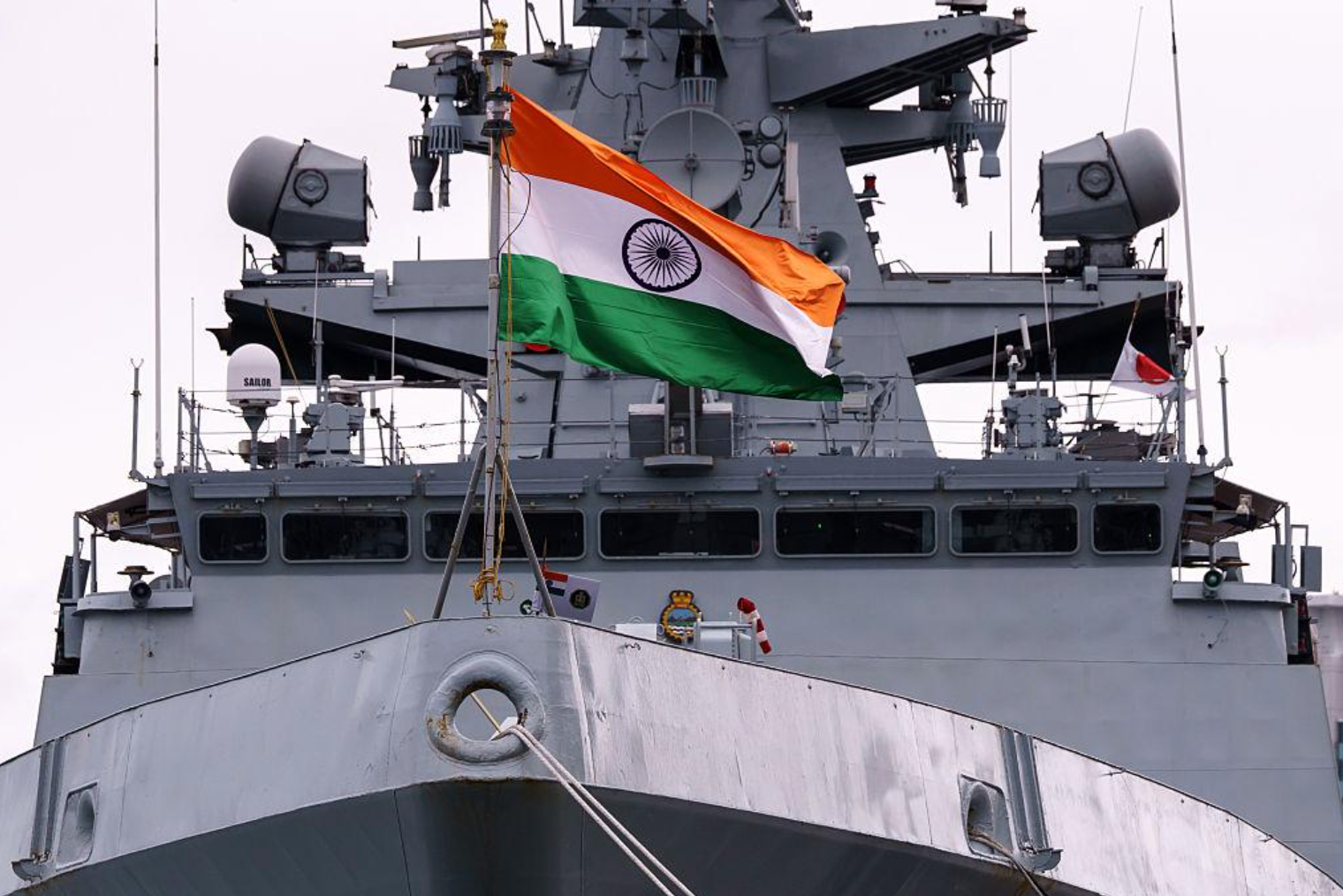
In five months New Delhi and Tokyo have turned a shared outlook into maritime security alliance for the Indo-Pacific. The security benefits will be felt as far as the Cape of Good Hope route and is good news for freedom of navigation globally.
By André Pienaar
In August 2007, Shinzo Abe stood before the Indian Parliament and spoke of the confluence of the two seas. The Pacific and Indian Oceans, he argued, were becoming a single strategic space, and Japan and India were the natural partners to keep it free and open. It was a vision ahead of its time. I returned from Japan this week, where I met with Prime Minister Takaichi on her return from the ASEAN Summit as part of the ARC delegation, convinced that its time has come.
A recent essay in Japan Forward captures the shift. In the Indo-Pacific, it argues, sea connectivity has stopped being a convenience of trade and become a pillar of economic security, and India and Japan are positioned to turn their dependence on the sea into shared resilience. That is exactly right. What strikes me most is the speed with which the two governments are now moving from the idea to the instrument.
Consider the past five months. In July, Prime Ministers Narendra Modi and Sanae Takaichi declared economic security a shared security interest and agreed a set of defence, economic and maritime arrangements. On 20 August in New Delhi, Defence Ministers Rajnath Singh and Shinjiro Koizumi signed a Memorandum of Arrangement on Maritime Security Cooperation between the Indian Navy and the Japan Maritime Self-Defense Force. On 19 November in Tokyo, the fourth 2+2 dialogue of foreign and defence ministers welcomed the memorandum and told both navies to turn it into concrete outcomes.
The memorandum commits the two navies to share information and build a common awareness of the sea, to exercise together, to support each other’s logistics and to protect sea lines of communication. It opens each country’s shipyards to the other’s warships for repair and maintenance. It provides for cooperation on mine countermeasures. It looks ahead to the joint design and building of naval ships.
This is architecture for a durable and transformative naval alliance. A shared picture of the sea tells two navies where to be. Shared yards keep them there. Shared industry replaces what they wear out. A standing framework holds the whole together when governments and headlines change. Each element is useful; together they amount to an alliance in everything but name.
The industrial pillar is innovative. Under the banner “Design with Japan, Make in India”, the two countries are fast-tracking co-production, beginning with the UNICORN naval mast, and their defence industries met in Tokyo in October for the third time. Japan brings design, technology and capital. India brings scale, shipbuilding capacity and the geography of a resident Indian Ocean power. Neither can supply alone what both can supply together, and navies are sustained by yards and factories as much as by fleets.
The strategic logic is as sound as the industrial one. India’s MAHASAGAR initiative and Japan’s Free and Open Indo-Pacific are, in the words of External Affairs Minister S. Jaishankar, closely aligned. Both countries sit alongside the United States and Australia in the Quad. Both are trading nations whose prosperity moves by sea, and both have watched what happens when a narrow passage is contested. A partnership between the leading democracy of the Indian Ocean and the leading maritime democracy of the western Pacific joins the two seas Abe described, and it does so with ships, yards and data instead of declarations.
There is a further benefit, and it lies well to the south-west. Since Houthi attacks began driving merchant shipping out of the Red Sea in late 2023, and since this year’s war with Iran confirmed the lesson, a great share of world trade has gone the long way round Africa. By early March, the Cape Chamber of Commerce and Industry was reporting a 112% surge in diversions around the Cape of Good Hope, each adding roughly ten to fourteen days to the voyage. Maersk, Hapag-Lloyd and CMA CGM rerouted. Tanker traffic past the Cape rose to its highest level since early 2025.
Every one of those ships bound to or from Asia crosses the Indian Ocean. An Indian Navy and a Japanese fleet that share what they see, sustain each other far from home and plan together make that crossing safer, and with it the eastern approaches to the Cape. The India–Japan alliance is therefore good news for the security of the Cape route. India is one of only two great powers that actively train sailors from the navies of the countries on the southern African maritime route. This should be welcomed in the capitals of SADC as warmly as in Washington DC, Canberra and London.
The mission now is delivery. The 2+2 asked for concrete outcomes, and the measure of this partnership will be warships in each other’s docks, a common picture on each other’s screens and jointly built equipment at sea.
Prime Minister Abe had the vision to speak of a confluence. At the southern tip of Africa, two oceans also meet, and the trade of the world now passes between them. The strategic partnership he imagined in New Delhi is being built at last, and its wake will reach all the way to the Cape.
