

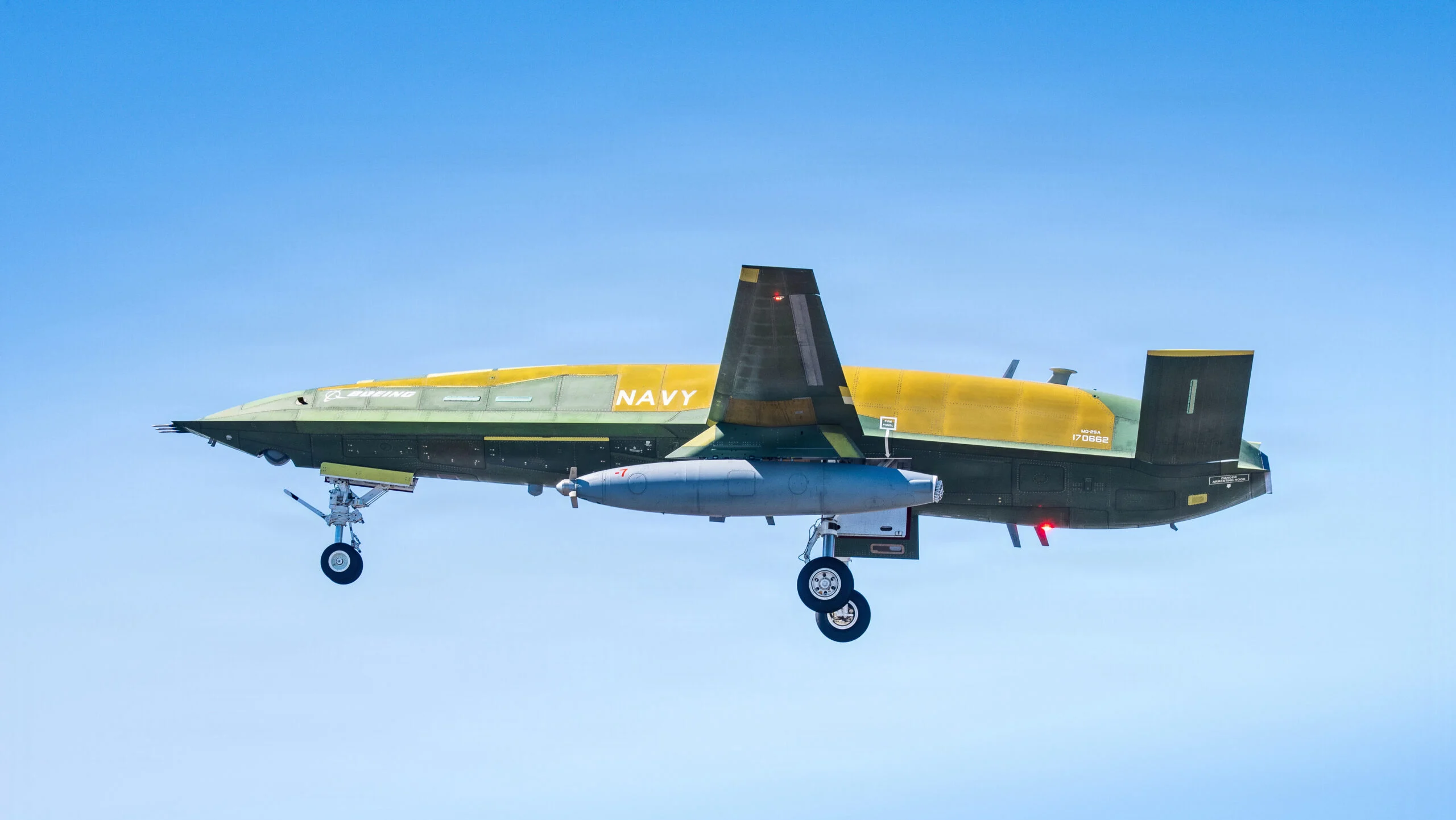
WASHINGTON — The Navy’s MQ-25 Stingray unmanned aerial system received the green light to move into low-rate initial production (LRIP), acting Secretary of the Navy Hung Cao said today.
As part of the production decision, known as Milestone C, an LRIP Lot 1 contract for three aircraft is expected this summer, along with priced options for three Lot 2 aircraft and five Lot 3 aircraft, according to the Navy.
“Unmanned refueling extends our reach against any adversary,” Cao said in a statement today. “Moving the MQ-25A Stingray to Milestone C and into production is arming our warfighters with a capability that increases the lethality of our Carrier Strike Groups. This is a decisive advantage that delivers our warfighters what they need to fight and win.”
The MQ-25 will primarily conduct refueling missions for carrier air wings, freeing up the F/A-18 Super Hornet for its strike mission, and may also complete intelligence, surveillance, and reconnaissance (ISR) missions.
“Boeing is honored to work alongside our U.S. Navy partner in achieving this historic milestone in the MQ-25A Stingray’s development life cycle,” Troy Rutherford, vice president of Boeing’s MQ-25 program, said in a statement today. “We remain focused on getting this game-changing unmanned aircraft into the hands of the fleet and integrated into the carrier air wing.”
The decision comes after a production representative aircraft completed its first test flight in April, where it launched from Boeing’s facility at MidAmerica Airport in Mascoutah, Ill., and demonstrated its ability to autonomously taxi, take off, fly, land, and respond to ground control station commands, Boeing said in a news release last month.
The Navy and Boeing said at the time that subsequent test flights out of the MidAmerica Airport are expected before sending the aircraft to Naval Air Station Patuxent River, Md., later this year to prepare for carrier qualifications.
The Navy’s fiscal 2027 budget request includes three MQ-25s. Originally scheduled for initial operating capability (IOC) in 2024, that milestone has encountered several delays and the Navy now expects it will reach IOC by FY29, according to budget documents released in April.
