

The U.S. submarine that sank an Iranian warship last month was trained and dispatched on short notice, the chief of naval operations said Monday, touting the quick turn as an example of the Navy’s efforts to adapt more quickly to the changing needs of war.
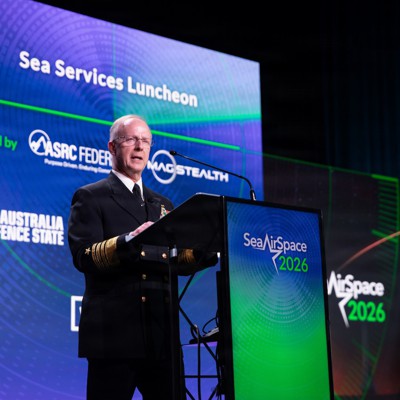
“Several weeks ago, after the initial strikes” on Iran, “the joint force needed some covert naval options—and fast, not a six-month deployment cycle and not a full strike group,” Adm. Daryl Caudle told an audience at the Navy League’s Sea-Air-Space conference outside Washington, D.C. “We took a submarine operating in the Indo-Pacific, ran it through a tailored training and certification package, sortied it west, and repositioned it in the Indian Ocean.”
On March 4, the attack sub Charlotte fired two torpedoes at the Iranian frigate Dena off Sri Lanka, becoming the first U.S. submarine to sink an enemy vessel with a torpedo since World War II, Pentagon officials have said.
“This was not improvisation,” Caudle said Monday. “That was a glimpse of the future force…We succeeded because we adapted faster than the problem.”
Adapting to battlefield problems will mean sending “tailored forces”—like a single retrained sub—rather than rigidly defined sets of naval assets, he said.
It will also mean warships that can take on new capabilities as quickly as a slingloaded shipping container can be delivered to a flight deck.
“If it fits in a container, I want it,” Caudle said, underscoring an initiative announced last month. “Containerization allows us to decouple payloads from platforms. To rapidly reconfigure forces, to tailor capability to mission to scale effects across the entire fleet.”
Hudson Institute analyst Bryan Clark noted that the submarine’s dash to the Indian Ocean was not the only example of the Navy’s use of tailored forces in the current conflict.
“For example, the Navy assembled a tailored force for the blockade of Iran and a separate tailored force for mine-clearing in the Strait of Hormuz,” Clark said.
But beyond that, he said, the CNO’s speech reflected an understanding of a key to modern warfare.
“He focused on adaptability, and suggested the ability to adjust tactics, systems, and force compositions is as important as mass in determining combat success,” he said.
Clark, whom Caudle has credited with key insights that are changing the way the Navy generates its forces, recently co-wrote a report on military adaptation. It describes how Ukraine’s maritime forces demonstrate the ability to adapt and how various organizational gaps in the U.S. military throttle it.
Clark and the report’s co-authors argue that fostering the kind of adaptation that wins wars requires organizing for it.“The enablers of modern warfare—cloud computing, software development tooling, artificial intelligence (AI), digital manufacturing, ubiquitous sensing—are globally available. The military that first builds the infrastructure to best exploit them will have a potentially insurmountable advantage,” they write.
They propose that “Adaptation in Contact—the deliberate weaponization of the learning cycle—represents the next revolution in military affairs.”
Caudle’s speech suggested he sees the same problem. He said the Navy’s biggest constraint is not technology, but “integration and adoption.” To speed new technology to the fleet, therefore, he is pushing a framework he calls the Fleet Introduction Operating System, intended to make updates to naval systems as seamless as downloading an app. The concept is part of Caudle’s Fighting Instructions, published in February, which laid out his broader strategy for how the Navy organizes, trains, equips, and fights.
Whether the Navy can institutionalize that kind of learning speed at scale remains the open question. The Hudson report said that building “digital rails”—intelligence pipelines, simulation environments, and secure deployment channels capable of pushing validated updates to the tactical edge in hours—would require sustained institutional investment, not just a renamed initiative.
