

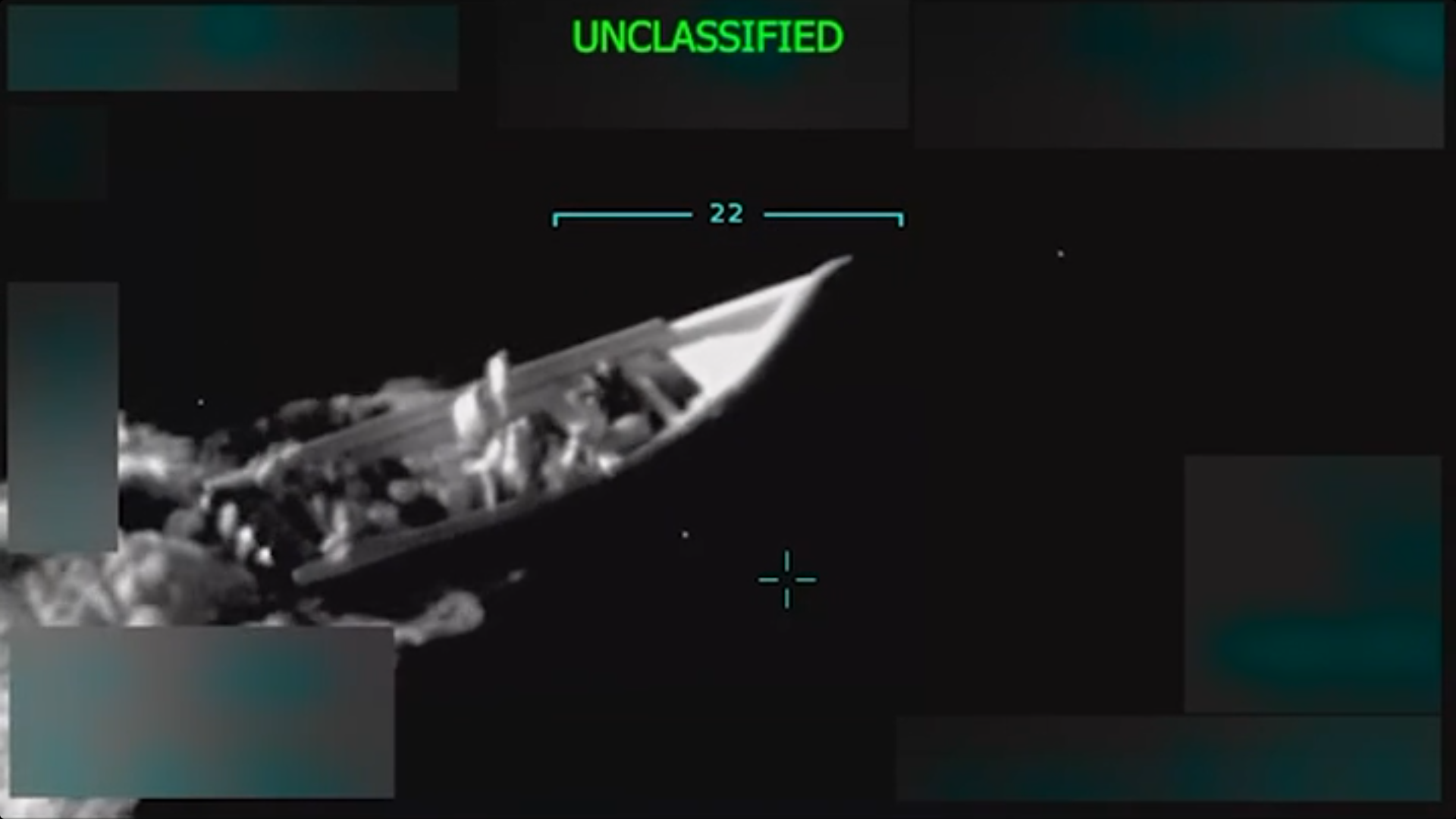
At a time when the US military is pummeling Iran with airstrikes and President Donald Trump again threatens to destroy Iranian infrastructure if Tehran doesn’t re-open the Strait of Hormuz, another war is raging much closer to home. But unlike the confrontation in the Middle East, which remains on the front pages, the ongoing battle in America’s own hemisphere is barely raising eyebrows.
Last November, Defense Secretary Pete Hegseth declared the initiation of Operation Southern Spear, a US military campaign designed to defeat so-called narco-terrorists in the Western Hemisphere. The mission came less than two months after the Pentagon began bombing small boats that were allegedly carrying drugs to the US through the Caribbean Sea and Eastern Pacific Ocean.
The United States has since conducted 66 strikes. Aside from reportedly killing an estimated 221 people in the process, some of whom may not actually be smuggling drugs, the mission has not actually succeeded in its core goals. And it’s using up military manpower and munitions at a time when the US is stretched on both.
The Trump administration claims the strikes are not only a much-needed reform to the anti-drug policies of the past but a policy change that is hitting Latin America’s criminal organizations where it hurts: in their wallets. In June, Trump boasted about a supposed 97 percent decline in sea-bound drug trafficking. The White House points to the ongoing boat strikes as a visible example of the so-called “Donroe Doctrine,” a play on the 1823 Monroe Doctrine, in which US power is wielded aggressively and unapologetically in America’s exclusive sphere of influence.
But all the happy-talk coming from the Trump administration is just that: talk. The Trump administration’s claims of counternarcotics success have no basis in fact. While traffickers have indeed been killed and bags of cocaine have no doubt sunk in the waters of the Pacific, the boat strikes are failing in their principal aim: cutting down on the amount of drugs reaching the US-Mexico border. Worse still, by militarizing counternarcotics, Washington runs the risk of making its counternarcotics goals more difficult to achieve and tainting its own reputation in the process.
In justifying why waging a literal war against drugs on the high seas is the right policy, Secretary of State Marco Rubio asserted that US Coast Guard-led interdictions in the region’s waters weren’t stopping traffickers from sending their product north. “What will stop them,” he said, “is when you blow them up, when you get rid of them.” Yet the United States has been blowing up alleged drug peddlers for the last nine months, and drug trafficking in the Western Hemisphere is still occurring.
This is not a surprise to anyone who has an even cursory understanding of how the drug trade operates. Like any other business, drug cartels respond to the rules of supply-and-demand and are constantly searching for the opportunity to grow their share of the market. Because the demand for illegal narcotics is so high in the United States and around the world, traffickers retain a major financial incentive to continue producing. Failing to do so merely leaves room for competitors to corner more of the market that’s valued in the hundreds of billions of dollars. This is especially true with cocaine, whose global demand is rising.
In an ideal world, US strikes would lead traffickers to save their own skins and look for a new line of work. In such a scenario, US law enforcement agencies would register a lower number of drug seizures at US borders and a spike in drug prices inside the United States as the supply dwindles. But as anticipated, drugs continue to flow despite the bombings.
According to US Customs and Border Protection, more cocaine was seized by US authorities in the eight months since the boat strikes started compared to the eight months preceding them. Cocaine prices have remained stable across this time frame as well, which suggests there aren’t any supply shocks. The market is well stocked. In short, if the US objective is to reduce trafficking, then Washington’s own statistics show that Operation Southern Spear is doing absolutely nothing.
The Trump administration’s military-centric anti-drug policy is beyond ineffective — it’s also costly. According to the Pentagon’s Special Inspector General, approximately $527 million was allocated for Operation Southern Spear between January-March 2026, the most recent figures available. Brown University has estimated that, if you go back to Aug 2025 when the buildup in SOUTHCOM began, cost estimates are closer to $5 billion. And that doesn’t count any incurred risk from having to shift forces out of other parts of the world to go to SOUTHCOM.
While this is a far cry from the more financially-intensive missions the US military is presently conducting — in comparison, the price tag for the war in Iran could reach $100 billion — it’s nevertheless another expense that Pentagon officials need to account for at a time when the 2027 National Defense Authorization Act is stalled and even some Republican lawmakers are increasingly skeptical about appropriating large US defense supplementals without comparable reductions in other areas of the federal budget.
Washington has encouraged countries in Latin America to bandwagon with the United States against the cartels and gangs running amok in the region. More often than not, this means enticing regional partners to adopt the US paradigm, where traffickers are treated as terrorists who deserve to be eliminated.
Yet drug trafficking is not international terrorism, no matter how many times the White House says otherwise. Mexico’s cartels may deploy terrorist-like tactics to kill their rivals, cow the population into submission and scare — or buy off — local police forces. But that’s where the similarities end. Unlike terrorist groups such as Al-Qaeda or ISIS, which seek to subvert governments and kill in the name of a nihilistic political objective, the cartels’ goal is to cash in and make their business easier to conduct.
Why is this important? Because failing to grasp this most basic fact will translate into bad policy. This is playing out in the region today. Many of Latin America’s governments increasingly believe they can kill or arrest their way out of the problem. This may make for good headlines and give politicians something to brag about, but over the long-term, more problems are created.
One of the most significant is the risk that unilateral US operations in the region’s waters will alienate traditional partners who don’t agree with US policy as a matter of principle or are otherwise concerned that intelligence cooperation with Washington could result in the deaths of innocent people. The United Kingdom, Colombia and the Netherlands have eliminated certain lines of information sharing with the United States on counter-narcotics in order to insulate themselves from being potentially liable for wrongful deaths. And there’s evidence that wrongful deaths have indeed occurred — the families of two victims killed by American strikes are currently suing the US government for what they allege are violations of both US law and international human rights law.
The operational impacts of the boat strikes can’t be ignored either. Killing drug traffickers on the high seas eliminates whatever intelligence value those traffickers may hold, including which criminal group they’re working for, who they’re taking orders from and where the production is happening. The boat strikes could therefore be making US law enforcement’s job even harder as potential sources and informants are eliminated.
Donald Trump isn’t the first American president who thought a tough-on-crime approach would compel traffickers to fold up shop. But he is the first to use the US military to test the theory. The results are in: it’s not working. Operation Southern Spear should be cut short.
Daniel R. DePetris is a fellow at Defense Priorities.
