

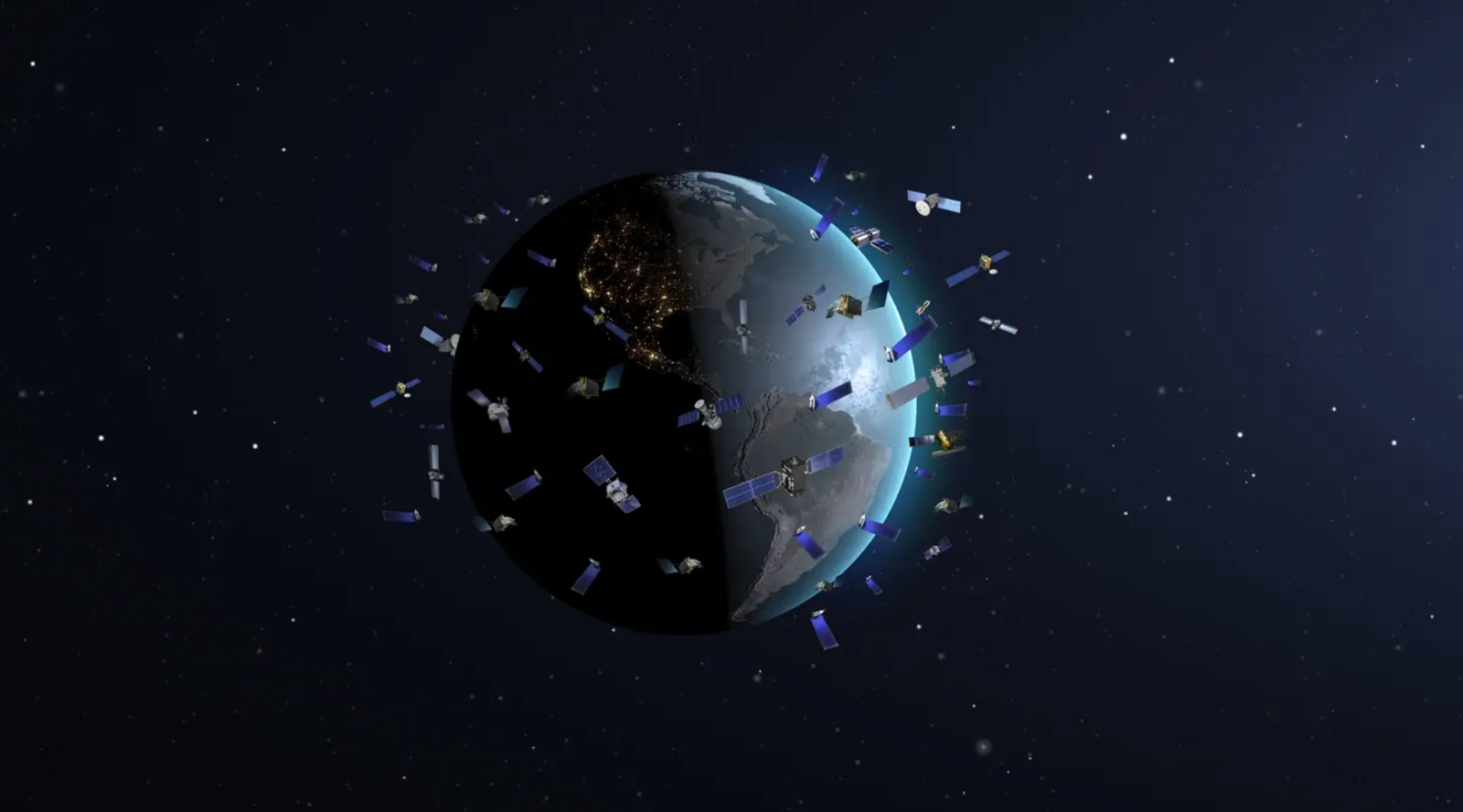
The Defense Intelligence Agency’s 2026 space threat assessment records what no previous edition did: space is now an active combat theatre.
By André Pienaar
There is a sentence in the Iran section of the Defense Intelligence Agency’s (DIA) new assessment, Challenges to Security in Space 2026, that should be read by the governments of each of our allies. With the onset of Operation Epic Fury, it records, “the U.S. and Iran took offensive actions against each others’ space capabilities to degrade and disrupt military actions on both sides.”
This is a critical development in warfare. When the DIA first published this report in 2019, counterspace weapons were a looming danger. The 2026 edition, with information current to July, describes space weapons in use: over Ukraine, across the Baltic, and in the Strait of Hormuz, where in June multiple organisations reported jamming that disrupted American aircraft and merchant shipping. Space is the high ground from which wars are supported. Space is now also front line on which wars are fought and often where the first contact with the enemy takes place.
The question the report forces is whether our policy has caught up. I do not believe fast enough except in the US where under President Trump first and second terms’ Space Force has become a fast growing combatant command including with its Special Forces. Elsewhere, there is still too much talk about space largely in the language of sustainability, debris and traffic management. Our adversaries talk about it in the language of strategic surprise and coercion.
Beijing’s lower threshold
The most important passage in the report is not a statistic, but a statement of doctrine. Chinese military researchers, the DIA notes, assert that using space weapons to coerce an adversary has “a lower threshold for use than nuclear weapons” and is “a more controllable, flexible, and credible option than nuclear deterrence.” PLA strategists very likely estimate that demonstrating counterspace capabilities in a crisis could degrade an adversary’s space architecture “as a prelude to war.”
This is worth reflection. Beijing sees space as the rung on the escalation ladder where it can strike first, signal resolve, and blind an opponent without crossing the nuclear threshold. The aim, in the PLA’s own literature, is to “blind and deafen the enemy.”
The industrial base behind that doctrine is formidable. China conducted 22 launches in 2016 and 93 in 2025. It placed 40 satellites in orbit in 2016 and 384 last year. Its intelligence, surveillance and reconnaissance fleet now exceeds 510 satellites, more than tripled since 2018, and can support the tracking and targeting of US and allied forces from the Korean Peninsula and Taiwan to the South China Sea and the Indian Ocean. Under China’s military-civil fusion laws, Chinese companies can be required to hand their data to the PLA. There is no meaningful line between Chinese commercial and military space.
China’s behaviour in orbit matches the doctrine. Its TJS series of so-called experimental communications satellites, 27 of them launched to date, have repeatedly approached within ten kilometres of other nations’ spacecraft in geostationary orbit. This is conduct that the DIA judges inconsistent with their stated mission. Shijian-21 has already towed a dead satellite out of geostationary orbit. Shijian-17 carries a robotic arm capable of grappling. Ground-based lasers can disrupt and damage satellites in low Earth orbit. And by the late 2020s China may field directed-energy weapons in space itself.
Moscow’s nuclear gamble
If China is building a precision instrument, Russia is building a doomsday device. The DIA states plainly that Russia is developing a satellite designed to carry a nuclear weapon, despite its obligations under the 1967 Outer Space Treaty. Such a weapon could cause the “rapid and sudden loss or degradation of thousands of satellites” operated by countries and companies worldwide, and would leave radiation belts that go on damaging spacecraft for years. Cosmos 2553, launched in February 2022 and described by Moscow as a test of space radiation on electronics, sits in an unusual, isolated orbit used by no other spacecraft.
This is the logic of a state that still has the largest nuclear arsenal in the world and of tactical nuclear weapons in particular. Russia lost nearly all of its commercial launch business between 2022 and 2024 and cannot match the West satellite for satellite, so it threatens to make orbit unusable for everyone. Meanwhile its co-orbital stalkers continue operations. Cosmos 2576 was placed in the same orbit as a US national security satellite and began moving towards it. Cosmos 2588 has manoeuvred within roughly 93 kilometres of another. Cosmos 2583 released a subsatellite in March 2025.
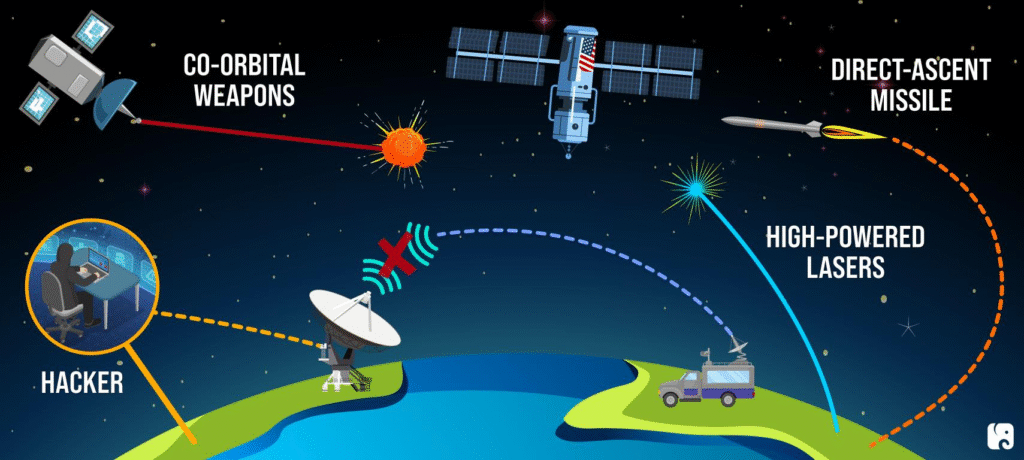
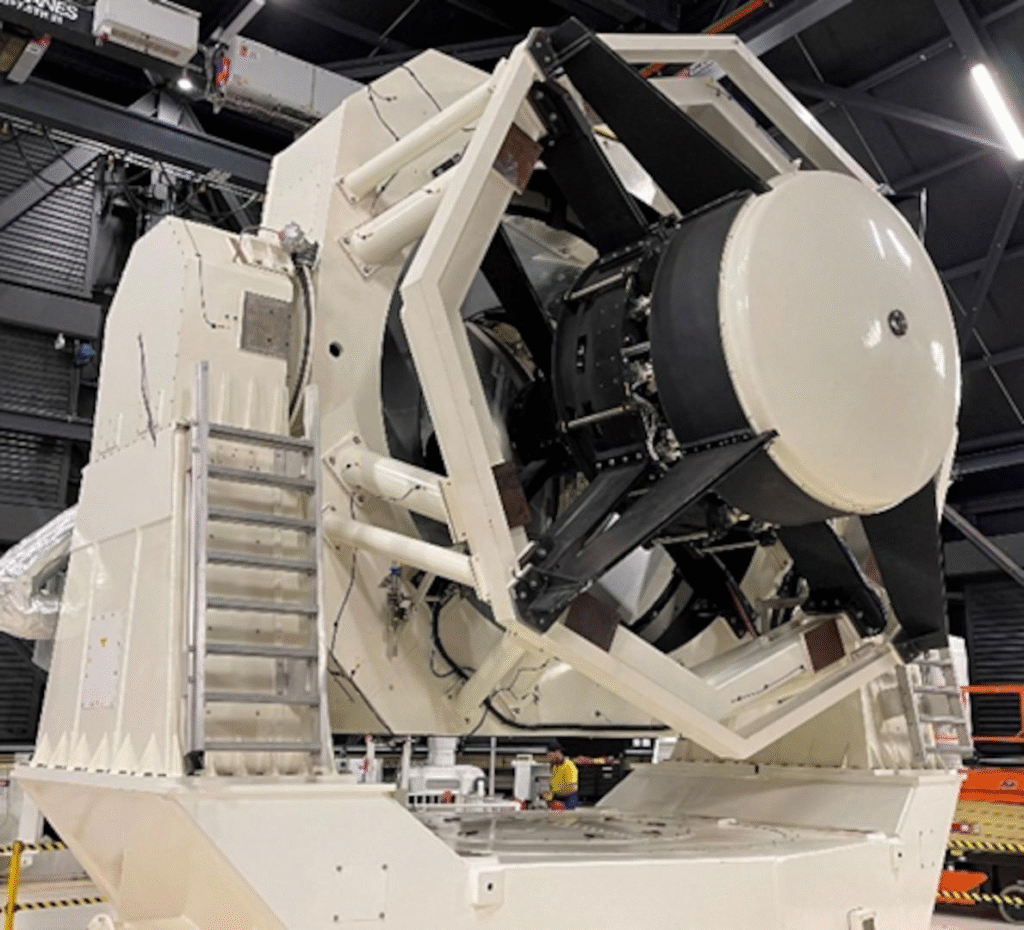
Peresvet lasers are deployed with five strategic missile divisions. Moscow has designated US commercial terminals and satellites supporting Ukraine as legitimate military targets, and GPS jamming blamed on Russia now stretches across the Baltic from Finland to Poland.
An axis of aggressors in orbit
The report’s most consequential finding may how the four powers in the axis of aggressors work together in space. After Western sanctions hit Russian satellite production, Roscosmos agreed to buy space components from China. In November 2022, the Russian private military company, Wagner contracted with Chinese commercial satellite firms for imagery satellites and data to support its operations in Ukraine and Africa. Another Chinese company, Spacety, supplied it with radar imagery of Ukraine. Russia has launched two remote-sensing satellites for Iran. At Vostochny in September 2023, Putin offered Kim Jong Un help with his space programme in exchange for munitions. North Korea has since threatened to destroy American satellites.
When the UN General Assembly voted in December 2024 on a resolution against weapons of mass destruction in outer space, it passed 167 to 4. The four opposing votes were Russia, Iran, North Korea and Syria. That vote is the clearest map of the axis we are likely to get. It also exposes the cynicism of the Sino-Russian campaign for treaties on “no first placement of weapons in outer space”. These are proposals that the DIA rightly calls unverifiable, advanced by governments that refuse to acknowledge their own counterspace programmes.
The Global South is the contested ground in space. China now operates BeiDou reference stations in eleven Sub-Saharan African countries and markets space services through its Belt and Road Space Information Corridor. Space cooperation, the DIA observes, is how Beijing and Moscow buy geopolitical influence. Every African, Gulf or Latin American government that defaults to Chinese navigation and ground infrastructure become part of the axis’ reach in space.
What deterrence in orbit requires
Five conclusions can be drawn from the DIA report.
First, we must treat space as a deterrence problem, not a traffic problem. NATO declared in 2021 that attacks to, from or within space could trigger Article 5. That principle must now be made concrete for commercial operators: an attack on an allied commercial satellite providing national-security services should be treated as an attack on the state that relies on it. Russia has already named those satellites as targets. Ambiguity on our side invites a test.
Second, there must be a diplomatic price to be paid for the deployment of a nuclear space weapon, otherwise the threat of nuclear war in space will become a reality. This is clearly the view of the international community based on the 167-to-4 vote in the UN against the deployment of nuclear weapons in space.
Third, we should not fund and provide the supply lines that enables others to dominate space as the strategic high ground. The US Treasury’s designation of Spacety should be the template, not the exception.
Fourth, build resilience through numbers. The answer to a nuclear or co-orbital threat is proliferation, manoeuvrability and the ability to reconstitute faster than an adversary can destroy. Here the US holds a decisive asymmetric advantage: the United States is, in the DIA’s words, the only country that fields an operational reusable launch programme. Beijing hopes to be second. Protecting that lead is the most important space-security investment we can make.
Fifth, we need to strengthen existing and build new alliances in space. Middle powers need sovereign eyes. Europe, Japan, the Gulf states and Africa’s leading economies cannot rely on others to tell them what is happening above their own territory. Space domain awareness should be treated as critical national infrastructure, built with trusted allies.
Congestion accelerates the risks in space as a war domain. More than 35,000 objects larger than ten centimetres now orbit the Earth, alongside an estimated 600,000 to 900,000 pieces of lethal, untrackable debris in low Earth orbit. Nearly half of that debris comes from three events, two of them Chinese and Russian anti-satellite tests. Planned constellations will probably triple the population of low Earth orbit by 2030. In an orbit that crowded, a single act of aggression can cascade into harm for every nation.
The DIA’s report is itself an act of deterrence by disclosure: it tells Beijing and Moscow that their programmes are known and observed. But disclosure is only the opening move. If the PLA doctrine is that counterspace coercion is the prelude to war, then the space between prelude and war, is where deterrence now lives.
